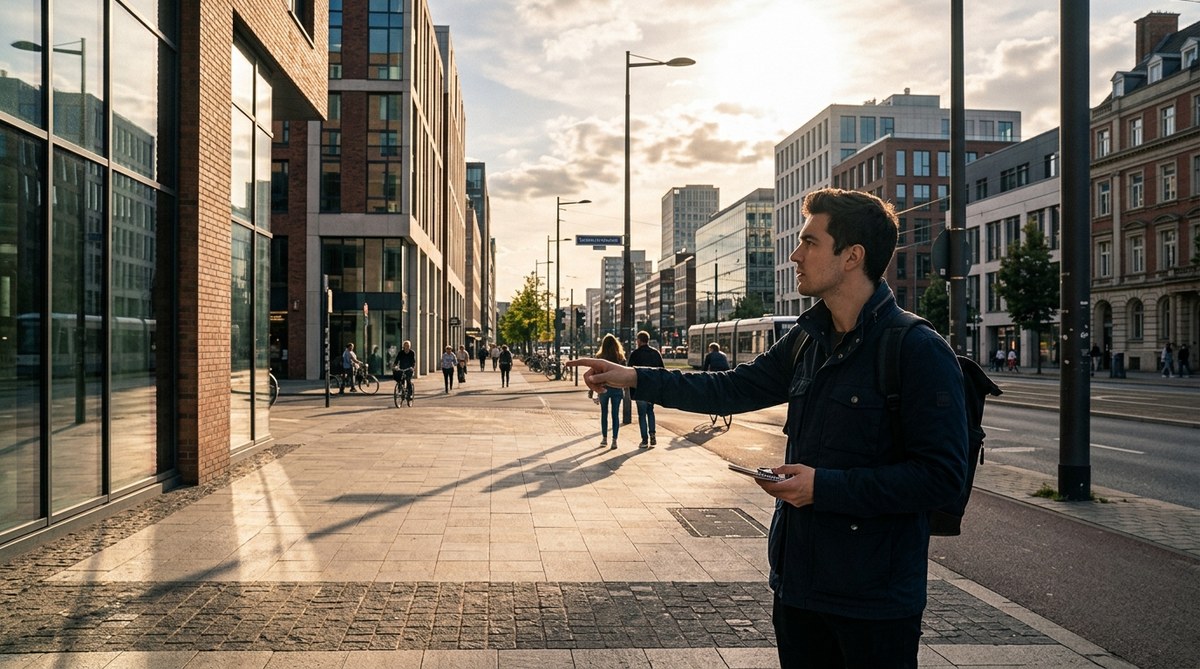
The sun helped people find their way long before anyone carried a phone. In a city, tall buildings create a constantly shifting pattern of light and shadow that tells a reliable story about direction and time. Learning to read that story lets you navigate urban blocks with the same confidence you would feel on a hiking trail.
In the Northern Hemisphere, shadows move clockwise and point north at solar noon. You can estimate direction by watching how a building shadow shifts over a few hours. Morning shadows fall westward, midday shadows shorten and point north, afternoon shadows stretch eastward. Paired with the sun position, these cues let you navigate city streets without a compass.
Why City Shadows Are More Reliable Than You Think
City streets are full of obstacles that block direct sunlight. That is actually good for navigation. A building casts a hard edged shadow that moves predictably as the earth rotates. Unlike a forest canopy that scatters light, an urban canyon creates clear lines between sun and shade.
The key principle is simple. The sun rises in the east, arcs across the southern sky (in the Northern Hemisphere), and sets in the west. Shadows do the opposite. They point west in the morning, north around midday, and east in the afternoon.
If you know your local time, you can estimate where the sun sits in the sky. That tells you which way your shadow should fall. When what you see matches what you expect, you know your orientation.
How to Read Shadow Direction in Three Steps
The process works anywhere the sun casts a clear shadow. Practice it on a sunny afternoon in your own neighborhood before you rely on it in an unfamiliar city.
-
Find a vertical object with a clear shadow. A lamppost, a street sign, or the corner of a building works best. The taller and more isolated the object, the sharper the shadow line.
-
Note the time of day. Use a watch or your phone. In the Northern Hemisphere, morning shadows (before 10 a.m.) point roughly west. Midday shadows (11 a.m. to 1 p.m.) point north. Afternoon shadows (2 p.m. to 4 p.m.) point east.
-
Point yourself in the right direction. Stand so the shadow points toward you. If it is morning and the shadow points west, you are facing west. Turn around and you face east. Now you know your cardinal direction.
This method gives you a rough bearing within about 15 degrees of true north. That is accurate enough to navigate a city grid.
A Common Mistake Table for Sun and Shadow Navigation
| Mistake | Why It Happens | How to Fix It |
|---|---|---|
| Confusing shadow direction with sun direction | Intuition says the sun is opposite the shadow, but beginners mix them up | Remember: the sun and shadow are always opposite. If the shadow points west, the sun is in the east. |
| Ignoring daylight saving time | The sun is highest around 1 p.m. DST, not 12 p.m. | Subtract one hour from your clock in DST months to get solar time. |
| Using a small shadow | A short object like a fire hydrant gives a fuzzy shadow at midday | Stick to tall, narrow objects like flagpoles or building edges. |
| Forgetting the Southern Hemisphere | Shadows point south at midday below the equator | If you travel to Australia or South America, reverse the rule. |
| Assuming a cloudy sky means no cues | Soft shadows still show a direction if you look for contrast | Hold a piece of paper upright. The brightest side faces the sun. |
Using Sun Position When Shadows Are Weak
Some days the sky is overcast. Or you are in a narrow alley where shadows blend into one another. On those days, look up.
The brightest part of the sky tells you where the sun is hiding. In urban settings, this works especially well because buildings block the horizon and create a visible gradient. The sky directly opposite the sun appears darker. The sky around the sun glows brighter.
To use this method, stand in an open spot and slowly turn in a circle. Notice which side of the sky feels warmer and brighter. That side faces the sun. Now apply the same logic: if the brightest sky is in the east, it is morning. If it is in the south, it is midday. If it is in the west, it is late afternoon.
“When the sun hides behind clouds, look for the glow. The brightest part of the sky is your compass. It takes practice to notice subtle differences, but once you see it, you cannot unsee it.”
Adaptation from traditional Polynesian wayfinding methods
Estimating Time From Shadow Length
Shadow length varies with the season and the latitude, but the ratio between an object and its shadow gives you a rough time estimate. At solar noon, a vertical object casts its shortest shadow. That shadow points due north (Northern Hemisphere) and tells you it is roughly midday.
Here is a practical way to use this for navigation.
- At 9 a.m. or 3 p.m., a shadow is about as long as the object is tall.
- At 8 a.m. or 4 p.m., the shadow is about twice the height of the object.
- At 10 a.m. or 2 p.m., the shadow is about half the height of the object.
If you see a street lamp with a shadow that stretches about three times its height, you know it is early morning or late afternoon. Combine that with shadow direction and you have a solid fix on both time and orientation.
This works best in spring and fall. In summer, shadows are shorter overall. In winter, they are longer.
Applying Sun and Shadow Navigation in a Real City
Picture yourself in downtown Chicago on a clear June afternoon. You step out of a subway station and need to head toward Lake Michigan, which is east. Your phone battery just died.
Look at the shadows on the pavement. If it is 2 p.m. Central Daylight Time (that is 1 p.m. solar time), shadows should point north. Find a building edge. The crisp shadow line runs north. The side of the street lit by sun faces south. East is to your right along the cross street.
Now check the sky to confirm. The brightest side of the sky is to the south. The north side of the sky looks slightly darker, even though the sun is bright. That matches your shadow reading. You turn right and start walking toward the lake.
You have just used two independent cues to confirm your direction. That is the power of cross referencing.
When Shadows Lie (And How to Catch It)
No natural navigation method is perfect. Shadows can trick you if you do not account for a few things.
- Reflected light. A white wall or a glass building can bounce sunlight into a shadow area, making it hard to see where the true shadow falls.
- Multiple light sources. In a plaza with reflective surfaces, you may see two faint shadows from different directions.
- Urban canyons. A very narrow street may block the sun entirely. In that case walk to the nearest intersection or open plaza to get an unobstructed reading.
- Seasonal extremes. In the deep summer, the sun rises far north of east and sets far north of west. Your shadow angles shift accordingly.
The fix for each is the same. Move to a spot with a clear view of the sky and a single tall object. Then apply the time based rules you already know.
Other Urban Cues That Work Alongside Shadows
Shadow reading is strongest when you pair it with other environmental signals. Here are useful companions.
- Wind patterns. In many U.S. cities, prevailing winds come from a consistent direction. In Chicago, the wind off the lake comes from the east. In San Francisco, the afternoon wind comes from the ocean in the west.
- Building numbers. In most grid cities, building numbers increase as you move away from a central baseline. In Manhattan, numbers increase as you go uptown (north).
- Moss on brick. Moss grows more often on north facing walls in the Northern Hemisphere because they stay damp and shaded.
- Street layout. Many older U.S. cities have streets that align with cardinal directions. Even in irregular cities like Boston, finding a major thoroughfare often gives you a directional anchor.
- Roof architecture. Steeper roof slopes often face north to shed snow in colder climates. Look at a church steeple or a tall house for this clue.
To build a complete toolkit, read about master urban navigation techniques without using a map. That guide walks you through combining shadow reading with other urban signals.
Building the Habit of Checking Shadows
Like any skill, reading sun and shadow works best when it becomes automatic. Here is a simple practice routine.
- Walk to work or school. Every day, note where the shadow of your building falls when you leave and when you return.
- Pick a landmark. Choose a tall building you see often. Check its shadow at different times of the week.
- Guess before you look. Before stepping outside, predict where the shadows will fall. Then check yourself.
- Use the sunset. Watch where the sun sets relative to your neighborhood streets. That gives you a west anchor for the rest of the evening.
Try practicing top tips for developing natural wayfinding skills in urban environments as part of your daily commute.
What Changes in Different U.S. Regions
The same principles apply everywhere, but regional quirks matter.
- Pacific Northwest. Frequent cloud cover means you rely more on sky brightness than hard shadows. The glow method becomes your primary tool.
- Southwest. Intense sun creates very sharp, long shadows even in the middle of the day. You can read direction more precisely here.
- Northeast. Tall buildings and narrow streets create deep urban canyons. You need to step into parks or plazas to get a clean reading.
- Midwest. Wide streets and low building heights make shadow reading easy. Grid layouts also simplify orientation.
- Hawaii and Southern Florida. These are close enough to the equator that midday shadows nearly disappear. Use early morning or late afternoon for the best readings.
For a deeper look at regional variations, see how to use environmental cues for accurate urban wayfinding in 2026.
The Sun and Shadow Navigation Toolkit
Here is a checklist of what you need to practice this skill.
- A watch or phone for time (analog helps visualize sun angle)
- A tall vertical object in a clear area
- Knowledge of whether you are in DST or standard time
- Awareness of your hemisphere (Northern vs. Southern)
- The ability to note sky brightness on overcast days
That is it. No apps. No gadgets. Just observation and a little practice.
To strengthen your overall awareness, check out enhance your urban navigation skills using environmental cues. It covers how to layer multiple cues for maximum confidence.
Putting It All Together on a Walk
Let us run through one full example so you can see how the pieces fit.
You are visiting Denver in October. It is 3:30 p.m. Mountain Daylight Time (2:30 p.m. solar time). You are at 16th Street Mall and need to find the state capitol building, which you know is east of where you stand.
You look at the shadow of a light pole. The shadow points roughly northeast. That tells you the sun is in the southwest. That matches 2:30 p.m. solar time in the Northern Hemisphere. You turn so the shadow points to your left. Now your body faces north. East is to your right. You walk that direction.
To confirm, you glance at the sky. The brightest quadrant is to the southwest. The shadows on surrounding buildings run consistent with that. You keep walking east and find the capitol.
The whole process took about 15 seconds.
Why This Matters for Urban Explorers
Cities are our modern wilderness. They have canyons, weather patterns, and landmarks just like a national park. Learning to read them with your eyes instead of a screen makes you more present and more capable. If your phone dies, you are not lost. You are just using older tools.
Shadow navigation is a skill you can practice anywhere. A parking lot. A sidewalk. A park bench. Every sunny day is a training session. Over time, you build a mental map of how light moves through your city. That map never runs out of battery.
For more ways to stay oriented without technology, read about top strategies for urban wayfinding when technology fails.
Start Seeing Shadows Like a Navigator
The next time you step outside on a bright day, stop for five seconds. Note where the shadows fall. Guess what time it is based on their length and direction. Check your watch. Adjust your intuition.
That small habit will transform how you move through a city. You will start noticing how the light changes block by block. You will develop a feel for the suns path that no map can give you. And you will never feel truly lost as long as the sun is shining.
Go outside right now and take a look at your own shadow. Which way does it point? What time does that suggest? That single observation is the beginning of a much larger skill set. Build on it one walk at a time.