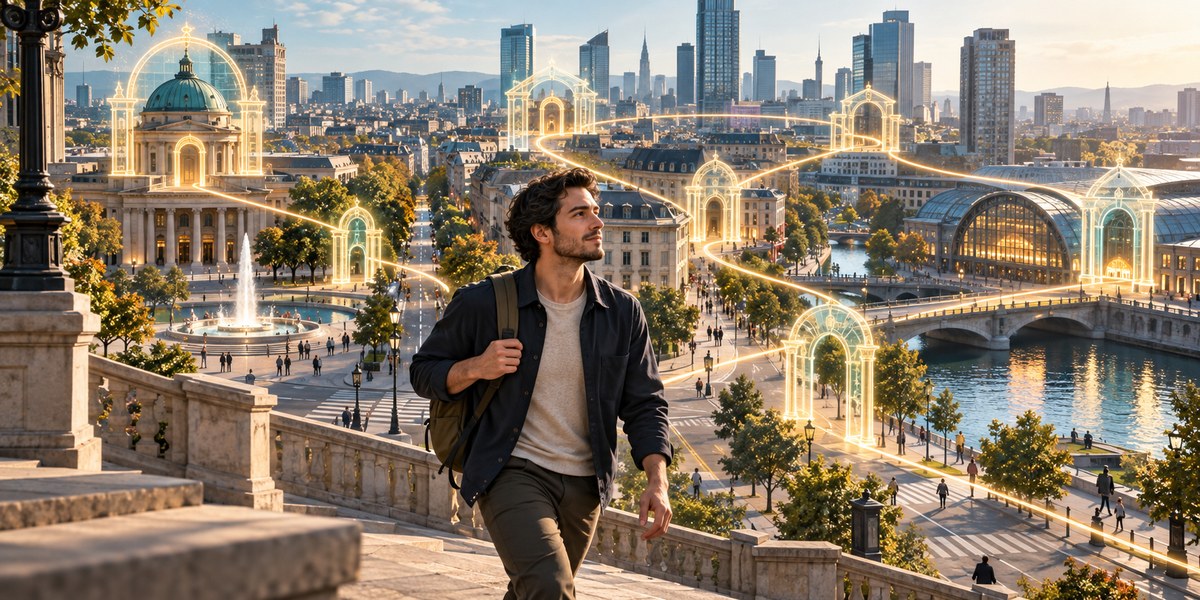
Your phone dies. The battery hits zero. The screen goes dark. You are standing at a busy intersection in a city you barely know. Most people panic in that moment. But you do not have to be one of them. You can train your brain to hold a complete map of any city inside your own head. This is not a party trick. It is a skill called memory palace navigation, and it has been used for thousands of years.
Memory palace navigation turns any city into a mental map you can walk through without a phone. You attach routes and landmarks to familiar locations inside your mind. This technique strengthens your spatial memory, builds confidence, and frees you from GPS dependency. In 2026, with more distractions than ever, this ancient skill is more useful than most people realize.
Why Your Brain Already Knows How to Do This
Your brain is wired for location. Think about your childhood home. You can walk through it in your mind right now. You know where the kitchen is in relation to the front door. You know how many steps lead to the basement. You did not study that layout. You just lived it.
Memory palace navigation uses that same instinct. Instead of memorizing a list of street names, you place them inside a structure you already know. Your childhood home. Your current apartment. Your favorite coffee shop. The spaces you know well become the skeleton of your mental map.
The ancient Greeks used this method to memorize speeches. They walked through a building in their imagination and attached each part of their speech to a different room. When they needed to recall the speech, they walked through the building again in their mind. The same principle works for city streets.
How Memory Palace Navigation Works in Practice
The process has three clear steps. Each one builds on the last.
-
Choose a familiar base location. This could be your own house, your office building, or a park you visit often. The key is that you know every corner of it without thinking.
-
Match streets and landmarks to spots in that base location. The entrance to the subway becomes your front door. The main square becomes your living room. The park bench where you meet friends becomes your kitchen table.
-
Walk the route in your mind. Start at your front door. Turn left into the living room. Walk through the kitchen to the back door. In the real city, that path takes you from the subway entrance, across the main square, and to the park bench.
The more you practice this walk in your head, the stronger the connection becomes. After a few repetitions, you do not need to think about it anymore. The route feels as natural as moving through your own home.
Common Mistakes and How to Fix Them
Most people try memory palace navigation and give up too soon. They expect perfect recall after one try. That is not how memory works. The table below shows the typical mistakes and the simple fixes.
| Mistake | Why It Happens | The Fix |
|---|---|---|
| Choosing an unfamiliar base | The brain has no solid structure to hold the map | Pick a place you could walk blindfolded |
| Attaching too many routes at once | Overload causes confusion | Start with one route and add more each week |
| Using vague landmarks | The brain needs specific visual cues | Use a bright red door or a unique statue |
| Skipping the mental walk | The connection never gets reinforced | Practice the walk three times before you go outside |
| Relying only on street names | Names are abstract and easy to forget | Focus on shapes, colors, and physical features |
The Techniques That Make It Stick
Memory palace navigation is not one single method. It is a set of techniques that work together. Here are the most effective ones for urban environments.
-
The landmark chain. Link five to seven landmarks in a row. Each landmark triggers the next one. The red mailbox. The blue awning. The corner bakery. The fire hydrant. The church steps. You only need to remember the first one, and the rest follow naturally.
-
The sensory layer. Add sounds and smells to your mental map. The rumble of the train. The scent of fresh bread. The sound of a street musician. These sensory cues stick in memory better than visual details alone. If you want to go deeper into this approach, read about how to use environmental cues for accurate urban wayfinding.
-
The reverse walk. After you memorize a route forward, practice it backward. Start at the destination and walk back to the starting point. This forces your brain to build a two way connection instead of a one way path.
-
The time stamp. Attach a time of day to each landmark. The coffee shop is where you stop at 8 AM. The park bench is where you sit at noon. The library steps are where you rest at 5 PM. Time anchors make the route feel more real.
Why GPS Is Weakening Your Natural Skills
Your phone gives you directions. It tells you when to turn. It recalculates when you make a mistake. That convenience comes at a cost. Your brain stops paying attention to the environment. It outsources navigation to the device.
Studies show that people who rely on GPS have less active hippocampus regions. That is the part of the brain responsible for spatial memory. The less you use it, the weaker it gets. Memory palace navigation reverses that decline. It forces your brain to build and maintain its own map.
This does not mean you should throw away your phone. It means you should give your brain the chance to do what it was designed to do. Use the GPS when you need efficiency. Use memory palace navigation when you want to truly know a place.
“The best navigators are not the ones who never get lost. They are the ones who can find their way back without a screen.” — Urban navigation instructor from a 2026 workshop in Portland
Building Your First Memory Palace for a City
Start small. Pick a neighborhood you visit often. It could be the area around your office or the blocks near your favorite grocery store. Do not try to map an entire city in one day.
Follow this numbered process for your first attempt.
-
Stand at a central point in the neighborhood. Look around. Identify five major landmarks. A tall building. A statue. A unique storefront. A park entrance. A bridge.
-
Assign each landmark to a room in your home. The tall building becomes your bedroom window. The statue becomes the dining table. The storefront becomes the front closet. The park entrance becomes the back porch. The bridge becomes the driveway.
-
Walk the real route between two landmarks. Pay attention to turns, distances, and visual cues. Then close your eyes and walk the same route in your memory palace. Move from your bedroom window to the dining table. Turn left at the closet. Step onto the back porch. Cross the driveway.
-
Repeat this mental walk five times before you go to sleep. Do it again when you wake up. Within three days, the route will feel automatic.
-
Add one new route each week. Connect it to the previous routes. Build a web of paths inside your memory palace.
The Tools That Help You Practice
You do not need any special equipment. Your own mind is the only tool required. But a few simple aids can speed up the process.
-
A notebook. Draw rough maps of the routes you are learning. The act of drawing reinforces the mental image.
-
Your own photos. Take pictures of landmarks and look at them before you practice the mental walk. This strengthens the visual anchor.
-
Voice notes. Record yourself describing the route out loud. Listen to the recording while you walk. Then try the walk without it.
-
A practice partner. Describe your memory palace to a friend. Explaining it out loud forces you to organize the information clearly.
If you want to expand your skills beyond the basic method, check out these top strategies for navigating cities intuitively in the digital age. They build directly on the memory palace foundation.
When to Use Memory Palace Navigation
This skill is not for every situation. If you are late for a flight, use your phone. But there are many moments when memory palace navigation shines.
-
Traveling to a new city. Build a basic memory palace before you arrive. Study a map for ten minutes. Assign the main streets to rooms in your home. When you land, you already have a mental framework.
-
Walking at night. Phones run out of battery. Streets look different in the dark. A memory palace does not depend on light or power.
-
Exploring without a plan. Put the phone away and let your memory palace guide you. You will notice details you never saw before. You will take turns you would have missed while staring at a screen.
-
Emergency situations. If your phone breaks or the network goes down, you still know how to get back to your hotel or your car.
The Difference Between Knowing and Memorizing
There is a gap between memorizing a list of street names and truly knowing a city. Memory palace navigation bridges that gap. When you attach a street to a room in your home, you are not just storing a name. You are storing a location, a direction, a feeling, and a relationship to other streets.
That is why memory palace navigation works better than flashcards or written notes. It uses the same neural pathways that your brain uses for real world movement. It is not artificial. It is natural.
People who learn this skill often report a strange side effect. They start noticing more about every city they visit. They pay attention to building shapes, street angles, and the position of the sun. They become better at estimating distances and predicting which direction a street runs. These are the same skills that help you read urban architecture for effective wayfinding.
Your Memory Palace Will Grow Over Time
The first memory palace you build will feel fragile. You will forget some connections. You will mix up routes. That is normal. Every memory needs repetition to become permanent.
After a few weeks, the palace becomes stronger. You can add more rooms. You can connect multiple neighborhoods. You can even build separate palaces for different cities. Each one exists in its own part of your imagination.
Some experienced navigators maintain memory palaces for ten or more cities. They can switch between them without confusion. The palaces do not overlap because each one is tied to a different base location. The Paris palace uses a different childhood home than the Tokyo palace.
Start Today With One Street
You do not need a special course or a paid app. You need one familiar place and one street you want to learn. That is enough to begin.
Pick a street near your home. Walk it from one end to the other. Notice five specific landmarks along the way. Assign each one to a room in your home. Close your eyes and walk the street in your mind. Do this once today. Do it again tomorrow.
By the end of the week, you will know that street better than most people know their own block. You will have proven to yourself that memory palace navigation is real. And you will be ready to build your next route.
What If You Could Navigate Any City Without Looking at a Screen
Think about what that would feel like. Walking through a new neighborhood with your head up. Seeing the architecture, the people, the small details that make a place unique. Knowing where you are without checking a map. Making a wrong turn and finding your way back without stress.
That is the promise of memory palace navigation. It is not about being perfect. It is about being present. It is about trusting your own brain to do something that phones have made us forget we can do.
In 2026, the average American spends over four hours a day looking at a phone screen. Much of that time is spent on navigation. Every minute you spend staring at a map is a minute you are not seeing the city around you. Memory palace navigation gives those minutes back.
Your Next Step
You have the instructions. You have the techniques. You know the common mistakes. The only thing left is to try it.
Walk outside right now. Pick one route you take regularly. The walk from your front door to the bus stop. The path from your office to the coffee shop. The stroll from your parking spot to the gym. Build a small memory palace for that one route.
Then come back and read this article again. See how much more sense it makes after you have tried it yourself. See how the techniques feel different when you are standing on the actual street.
Memory palace navigation is not a theory. It is a practice. And like any practice, it gets better the more you do it. Start today. Start small. Start with one street. Your brain will thank you.
For more ways to strengthen your natural navigation abilities, take a look at these practical techniques for mastering urban navigation without a map. They pair perfectly with the memory palace method and will make you feel at home in any city.