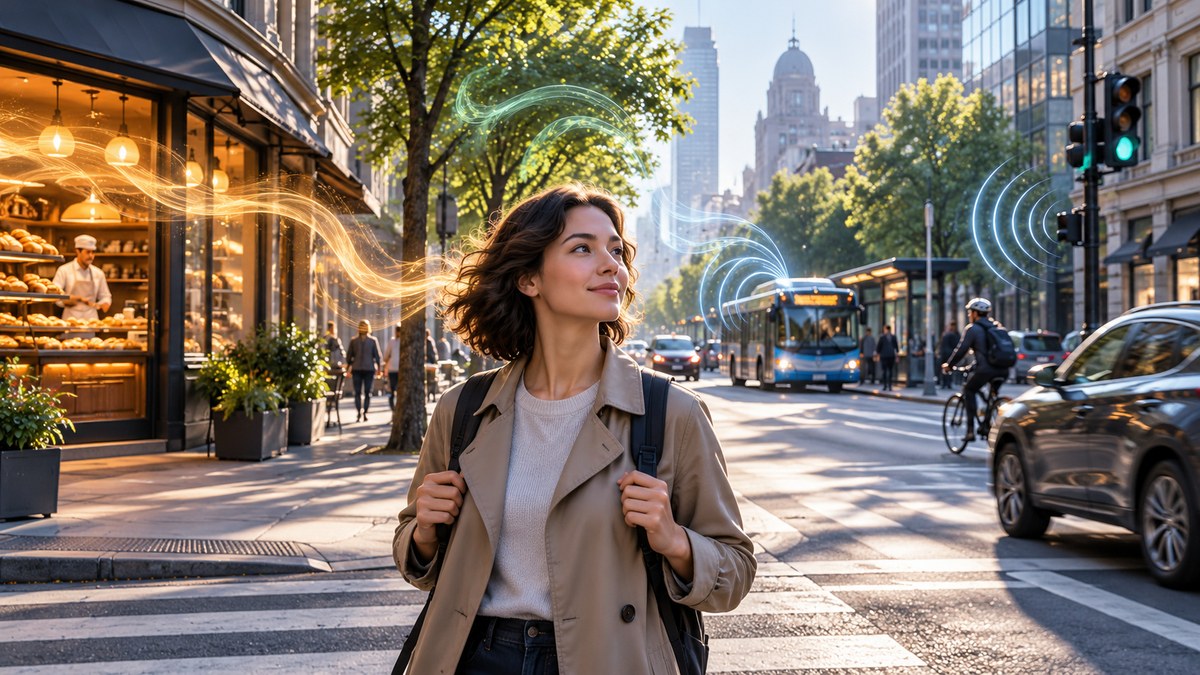
You step off a subway train in a new city, and your phone shows zero bars. Panic flickers for a second, but then you take a breath. The air carries a story. A faint whiff of roasting coffee from the northeast. The low hum of a highway ramp to the south. The distant clatter of a produce market two blocks west. In that moment, your nose and ears become your most reliable navigation tools. Learning to read these sensory signals is the core of city smell orientation 2026, a skill that turns any urban maze into a familiar landscape.
Your sense of smell and hearing can act as a backup GPS when your phone dies or signals get lost. By mapping the unique scent zones and sound corridors of a city, you can pinpoint your location and direction within minutes. This guide gives you a step-by-step process to build a personal sensory map, helping you move through any urban environment with confidence in 2026.
Why Your Nose Knows the Way Better Than Your Phone
Smartphones are great at giving directions, but they fail in tunnels, during storms, or when the battery dies. Your senses never switch off. They are always running in the background, processing data that your conscious brain often ignores. In 2026, as more people look for ways to disconnect from constant screen time, sensory navigation is making a comeback.
The human nose can detect over one trillion scents. Yet most of us walk through cities with our noses buried in a map app. Think about it. You can smell the difference between a Dunkin’ Donuts and an artisanal bakery from half a block away. You can hear the difference between a bus idling and a delivery truck backing up. These are not random noises or smells. They are location markers.
Consider a neighborhood in San Francisco. The fog carries a specific saltiness near the coast. As you move inland, that salt fades and is replaced by the scent of damp pavement and eucalyptus trees. Your brain can learn these transitions. Once you train it, you will never need to check your phone to know you are heading toward the water.
The Three Layers of Urban Sensory Data
To master city smell orientation 2026, you need to listen to three layers of information. Each layer gives you a different piece of the puzzle.
- Layer one: Base scents. These are the permanent or long-term smells of a district. A bakery district smells like yeast and sugar. A financial district smells like concrete, exhaust, and expensive cologne. A waterfront area smells like brine and fish. These scents do not change much throughout the day.
- Layer two: Transient sounds. These are the moving audio cues. The rumble of a specific subway line. The bell of a streetcar. The chatter from a schoolyard at 3:15 PM. These sounds give you time-based orientation.
- Layer three: Seasonal and time-based shifts. In 2026, cities are experimenting with seasonal scent installations in parks. A summer block party leaves the smell of grilled meat and sunscreen. Autumn brings wet leaves and woodsmoke. Your orientation changes with the calendar.
How to Build Your Sensory Map in Five Steps
You can start using these techniques today. Here is a numbered process to build your own sensory map of any city.
- Start at a known anchor point. Find a landmark you recognize, like a major train station or a famous park. Stand still for sixty seconds. Close your eyes. List every distinct smell and sound you notice. Write them down in a notes app or on paper.
- Walk a straight line for three blocks. Pick a direction and walk. Do not turn. At each intersection, pause and note how the smells and sounds change. Does the traffic noise get louder or softer? Does the scent of food fade? This tells you if you are moving toward a commercial zone or a residential one.
- Create a mental smell compass. Assign a scent to each cardinal direction from your anchor point. For example, north might smell like the river. South might smell like a bus depot. East might smell like a bakery. West might smell like a parking garage. Now you have a compass that works without a magnet.
- Map the sound gradients. Cities have sound walls. A highway creates a constant drone. A school zone has a burst of noise at certain hours. A construction site has rhythmic clanging. Learn the sound signature of each zone. If the drone of the highway is getting louder, you know you are walking toward it.
- Test yourself at random points. After building your map, go to a spot you have never visited. Without looking at a map, try to point toward your anchor point using only smell and sound. Check your accuracy. Most people are surprised at how close they get.
Common Mistakes and How to Fix Them
Even experienced urban explorers make errors when relying on their senses. The table below outlines the most common mistakes and the corrections you can make.
| Mistake | Why It Happens | The Fix |
|---|---|---|
| Confusing similar food smells | Two taco trucks within a block create overlapping scents | Focus on the cooking oil type. Corn oil smells different from canola. |
| Misjudging distance by sound | Sound bounces off tall buildings, making things seem closer | Note the echo. A sharp echo means a nearby building. A flat sound means an open space. |
| Relying on one sense only | Smell can be blocked by wind or rain | Always cross-reference with sound. If the smell is gone, use the nearest sound cue. |
| Ignoring the wind direction | Your nose only smells what the wind brings you | Check a flag or a tree to see which way the wind blows. Factor that into your reading. |
| Overlooking time-based sounds | A school bell at 3 PM is a strong cue, but it stops on weekends | Know the schedule of the area. Weekend sounds are different from weekday sounds. |
“The city is a living organism. It breathes. It sweats. It hums. If you learn its rhythms, you can find your way through it with your eyes closed. The nose is the most underrated navigation tool we have.” – Dr. Lina Marchetti, urban sensory researcher at NYU.
Putting It All Together in a Real Scenario
Imagine you are in downtown Chicago. You come up from the subway at Clark and Lake. Your phone is dead. You want to head toward the Chicago Riverwalk. You take a breath.
The air has a metallic tang mixed with the scent of hot dogs from a nearby stand. That is a typical Loop smell. You hear the elevated train rumbling overhead. That is the Brown Line. You know the river is west of the train tracks. The wind carries a faint, muddy smell from the west. That is the river. You start walking west, following the breeze. The metallic tang fades. The mud scent grows stronger. After two blocks, you see the water. You arrived without a single glance at a screen.
This is not magic. It is training. And you can learn it.
How to Adjust Your Sensory Orientation for Different American Cities
Each city has a unique sensory fingerprint. In 2026, understanding these fingerprints helps you adapt your technique.
- New York City: The smell of steam rising from subway grates is a constant. Use it as a compass. The steam is often warmer and more humid near major transit hubs. The sound of taxi horns is louder in Midtown than in the Village.
- Los Angeles: The scent of jasmine and eucalyptus fills residential hills. The smog layer creates a distinct chemical smell near freeways. Use the sound of the Pacific Ocean as a distant baseline. If you hear waves, you are heading west.
- New Orleans: The smell of beignets and chicory coffee marks the French Quarter. The sound of streetcars on St. Charles Avenue is a clear line of orientation. The humidity carries scents farther here, so you can smell a po-boy shop from three blocks away.
- Seattle: The scent of rain on concrete is a signature. The sound of ferries and seaplanes gives away the waterfront. The smell of roasting coffee from the many local roasters creates a grid of coffee-scented zones.
The Future of Sensory Navigation in 2026
Cities are becoming more aware of their sensory landscapes. Urban planners are using scent zoning to create better pedestrian experiences. Some parks in Portland now have scent gardens with herbs and flowers that change with the season. These are intentional orientation points.
At the same time, the Digital Olfaction Society is working on technology that can digitize smells. This might sound like science fiction, but it is happening now. In the future, your phone might be able to tell you, “You are near a bakery that opened last week,” based on scent data. But for now, your own nose is the best tool you have.
If you want to strengthen your skills further, check out this guide on how to use environmental cues for accurate urban wayfinding in 2026. It covers how to combine smell, sound, and sight for a complete navigation system.
Your First Sensory Walk Challenge
Here is a simple challenge to start today. Pick a neighborhood you know well. Go to its center. Close your eyes for thirty seconds. Write down three smells and three sounds. Now walk one block in each direction. Note how the sensory profile changes. Do this once a week for a month. By the end, you will have a detailed mental map of your area that no app can replicate.
Trust Your Senses, Not Just Your Screen
The world is not flat. It is layered with information that your eyes alone cannot see. In 2026, the ability to navigate without a phone is not just a party trick. It is a survival skill. It is a way to stay connected to your environment. It is a method to reduce screen time and increase real-world awareness.
The next time you step out of a train station, take a breath before you pull out your phone. Let the city tell you where you are. You might be surprised at how much you already know. For more on building these skills, read about developing your urban navigation skills using sound and scent cues. Your nose has been waiting for you to listen.