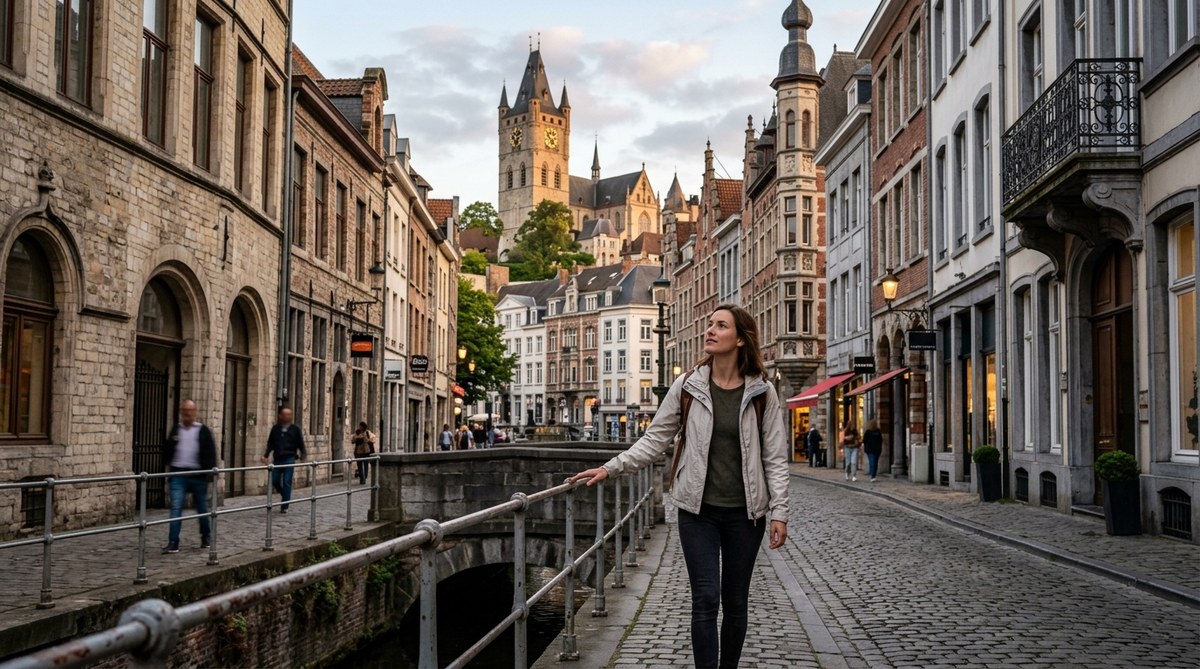
You step out of a subway station in a city you have never visited before. The streets angle off in unexpected directions. Your phone is dead. For a second, a familiar dread creeps in: how will you find your way? Then you take a breath. You look up at the buildings. You notice the slope of the street. You listen for the distant hum of a major avenue. In that moment, you realize something important: the city itself is a map, and you already know how to read it.
You can navigate cities without a map by training your brain to observe three things: the urban grid, landmark chains, and directional cues from the environment. This guide gives you a practical system that works in any U.S. city. Learn to move confidently through unfamiliar streets using architecture, street names, sun position, and your own senses.
Why Your Phone Is Not Your Best Navigation Tool
Relying on GPS every time you step outside actually weakens your natural wayfinding ability. A 2020 study from the journal Cognitive Research found that people who frequently use turn-by-turn navigation build weaker mental maps of the areas they travel. They can get from point A to point B, but they struggle to recall the layout of the neighborhood or point north when asked.
In 2026, almost everyone carries a smartphone, but batteries die, signals drop, and data plans run out. More importantly, the feeling of being lost in a new place is one of the best ways to truly learn it. When you navigate without a map, you engage your brain in a way that builds lasting spatial memory. You start to see patterns: the way a city was planned, the logic behind its street numbers, the subtle clues that tell you which direction you are facing.
The goal here is not to throw away technology. It is to build a backup system that works every time, anywhere. The techniques below are the same ones used by seasoned travelers, delivery drivers, and urban explorers who can master urban navigation techniques without using a map. They are simple, repeatable, and reliable.
The Three Pillars of Map-Free City Navigation
You do not need a complicated system. Just three main skills: reading the grid, using landmarks, and sensing direction. Master these, and you can find your way almost anywhere.
1. Decode the Urban Grid
Most American cities follow one of three patterns: the classic grid (like Manhattan or Chicago), the radial layout (like Washington D.C. or Indianapolis), or the organic tangle (like Boston or Pittsburgh). Once you identify which pattern you are in, you can predict where streets go.
- Grid cities: Streets run in parallel lines. Numbered streets (1st, 2nd, 3rd) almost always run one way; named avenues run the other. In Manhattan, streets run east-west and avenues run north-south (with some exceptions). If you know the numbering goes up as you move north, you can guess your location from any street sign.
- Radial cities: Major roads converge on a central point (often a capitol building or a roundabout). Streets are named for their direction from that center (North Capitol Street, South Capitol Street). If you find the center, you can orient yourself by following the radiating spokes.
- Organic cities: These old, winding layouts follow historical paths (animal trails, cow paths, rivers). Here, landmarks become critical. But even in Boston, many streets follow the shoreline or the original town commons. Look for water or a park as an anchor.
When you arrive in a new city, spend the first five minutes noting the street grid. Ask yourself: Do the numbers increase in one consistent direction? Are there diagonal avenues? Is there a river or a major highway that acts as a boundary? This mental snapshot is your foundation.
2. Build a Chain of Landmarks
A landmark is not just a tall building. It is any feature that stays in the same place and is easy to recognize. The best landmarks are visible from multiple angles and unlikely to be confused with something else.
To navigate cities without map, create a mental chain of three to five landmarks that connect your starting point to your destination. For example:
- Start: The red brick church with the tall spire.
- Turn left at the corner where the coffee shop has a green awning.
- Continue until you reach the fountain in the small park.
- The library with the clock tower is on your right.
This chain method works because it does not require you to remember street names. You simply walk from one visual cue to the next. As you walk, glance back over your shoulder so you can recognize the same landmarks on the return trip.
For longer trips, choose landmarks that are visible from a distance: water towers, bridges, stadiums, or unusual skylines. In a city like Seattle, the Space Needle can orient you from miles away. In Chicago, the Hancock Building and Willis Tower create a silhouette that tells you which part of the city you are in.
If you want to go deeper, read about how to read the urban environment to navigate without a map in 2026. That article covers how architecture style, building height, and even sidewalk materials can signal changes in a neighborhood.
3. Use the Sun, Shadows, and Wind
You do not need a compass to know north. In the northern hemisphere, the sun rises in the east and sets in the west. At noon, the sun is generally in the south (slightly offset depending on daylight saving time). Look at shadows: in the early afternoon, shadows point north. Use this simple rule to get your bearings.
But the sun is not the only clue. Wind often comes from a prevailing direction (in many U.S. cities, west or southwest). If you can feel the wind on your face consistently in one area, it can act as a directional anchor. Similarly, noise can help: highways, train tracks, and stadiums all produce steady sound that can be tracked.
Practice these directional skills in your own neighborhood before you travel. Spend ten minutes walking without your phone, and try to point north every time you stop. This builds a mental compass that will serve you well.
A Step-by-Step Process to Navigate Any City Without a Map
Follow this sequence whenever you enter an unfamiliar urban area. It takes less than a minute and sets you up for success.
- Stop and scan. Stand still for ten seconds. Look up, down, and all around. Note the street pattern, the sun position, and any major landmarks (rivers, hills, tall buildings, parks).
- Identify the anchor. Pick one landmark that is visible from almost everywhere: a mountain, a water tower, a skyscraper, a bridge. This is your north star for the day.
- Decide a primary direction. Use the sun or a shadow to determine which way is north. If you are in a grid city, confirm that street numbers increase in that direction.
- Create a mental landmark chain between where you are and where you want to go. Write it down in your mind: “Left at the statue, right at the blue awning, straight past the park.”
- Walk and confirm. Every few blocks, glance at your anchor landmark. If it has moved to your right when it should be ahead, you have drifted. Correct your path.
- Recalibrate at intersections. Cross streets are checkpoints. In grid cities, note the cross street numbers to estimate how far you have traveled.
This process is the foundation for learning to navigate any U.S. city using only your senses and landmarks. Practice it in your own city first, where you know the streets, so it becomes automatic.
Common Techniques vs. Painful Mistakes
Not every technique works in every city. The table below shows what to do and what to avoid.
| Technique | What To Do | Common Mistake |
|---|---|---|
| Sun orientation | Check the sun at multiple times of day. Use shadows. | Assuming the sun is always directly south at noon (it varies with daylight saving time). |
| Landmark chain | Use 3-5 landmarks; glance back to memorize the reverse view. | Choosing a landmark that looks identical to others (e.g., generic brick buildings). |
| Street grid logic | Know if numbers increase northward or eastward. | Forgetting that some cities have diagonal avenues that break the grid. |
| Sound clues | Listen for highway noise, train horns, or stadium crowds. | Following noise that changes direction (e.g., traffic with varying density). |
| Water flow | In cities with rivers, note which way the water flows (downhill). | Assuming a river runs straight; many twist and can confuse direction. |
| Asking locals | Ask for “the tall building that looks like X” or “the street with the bakery.” | Asking for a street number or name without knowing its orientation. |
“The most confident city navigators are the ones who treat the city as a conversation. They ask questions of the environment: why does this street curve? Why are the buildings taller here? The answers are always there. You just have to look.” — Lena Marchetti, urban design researcher and author of Wayfinding Without Screens
Adopting this mindset will help you avoid the trap of staring at your phone instead of the world around you.
What to Scan for as You Walk
When you navigate cities without a map, your eyes and ears become your instruments. Train yourself to scan for these cues automatically as you move:
- Street signs: Even without a map, read every street sign you pass. Correlate the name with a memorable image (e.g., “Maple Street” reminds you of a maple tree). This builds a verbal map in your head.
- House numbers: In most U.S. cities, house numbers increase by roughly 100 per block. If you know the address you need, you can count blocks.
- Business names: A distinctive storefront acts as a landmark. A bright yellow laundromat or a vintage diner are hard to forget.
- Sidewalk texture: Brick sidewalks often indicate historic districts. Wide sidewalks with trees suggest a residential area. Narrow sidewalks with heavy foot traffic point to commercial zones.
- Shadows and light: The angle of sunlight tells you time of day and direction. Long shadows mean morning or late afternoon. In midday, the sun is high and shadows are short.
- Noise levels: A sudden drop in traffic noise often means you have turned into a quieter side street. Steady rumble means you are near a highway or train line.
- Smells: Bakeries, coffee roasters, fish markets, and florists are unique olfactory markers. They can help you identify a specific area without seeing a sign.
- People flow: Crowds of people moving in one direction often lead to a transit stop, a market, or a plaza. Follow them if you want to find a hub.
These cues are the building blocks of what experts call “spatial literacy.” The more you practice, the more automatic the scanning becomes. For a deeper practice regimen, check out these top tips for developing natural wayfinding skills in urban environments.
Your Body as a Compass: Using Proprioception
You have a built-in inertial navigation system: your own body. With practice, you can sense how many steps you have taken, how many turns you have made, and the approximate angle of each turn. This is called “path integration,” and animals use it constantly. Humans can too.
To train it, walk a new route without looking at any map or GPS. After arriving at your destination, close your eyes and try to retrace the route in your mind. Estimate distances by counting steps (100 steps is roughly one block in many cities). Over time, you will become aware of subtle changes in direction.
Combine this with your mental landmark chain. When you round a corner, note the angle: was it a 90-degree turn or a 45-degree diagonal? Your body remembers. This technique is especially useful in cities where the grid is skewed, such as Washington D.C., where avenues slice through blocks at odd angles.
A great companion piece is this guide on how to develop your urban senses for seamless city navigation in 2026. It explains how to fine-tune your awareness of space and movement.
What Happens When You Get Lost (and You Will)
Getting lost is not a failure. It is practice. Every time you lose your way, you gain information about the city. The best navigators treat wrong turns as data.
When you feel lost, stop. Look for your anchor landmark. If you cannot find it, look for a water tower, a church spire, or a crane on a construction site. Estimate the direction you came from. Retrace your steps to the last familiar landmark. Do not panic. Panic makes you walk faster in the wrong direction.
If all else fails, ask a local. But do not ask, “Where is Main Street?” Ask in a way that confirms your own orientation: “Is Main Street two blocks north from here?” The answer will either confirm or correct your mental map.
For a full set of backup strategies, read this article about top strategies for urban wayfinding when technology fails.
Your City Is a Living Map
You do not need a screen to show you the way. The streets, the buildings, the sun, the sounds, and the people all carry information. Your job is to pay attention.
Start small. The next time you walk to a coffee shop you have visited before, leave your phone in your pocket. Notice the landmarks you pass. Look at the street numbers. Feel the direction of the wind. By the time you reach your destination, you will have built a tiny mental map of that route. Do this every day for a week, and you will be surprised how quickly your orientation improves.
In 2026, when digital maps are everywhere, the ability to navigate cities without a map is a superpower. It makes you more independent, more observant, and more connected to the places you travel through. The city is not a maze. It is a story, and you can learn to read it one block at a time.
Now go outside, pick a direction, and walk. Your first lesson starts the moment you step out the door.