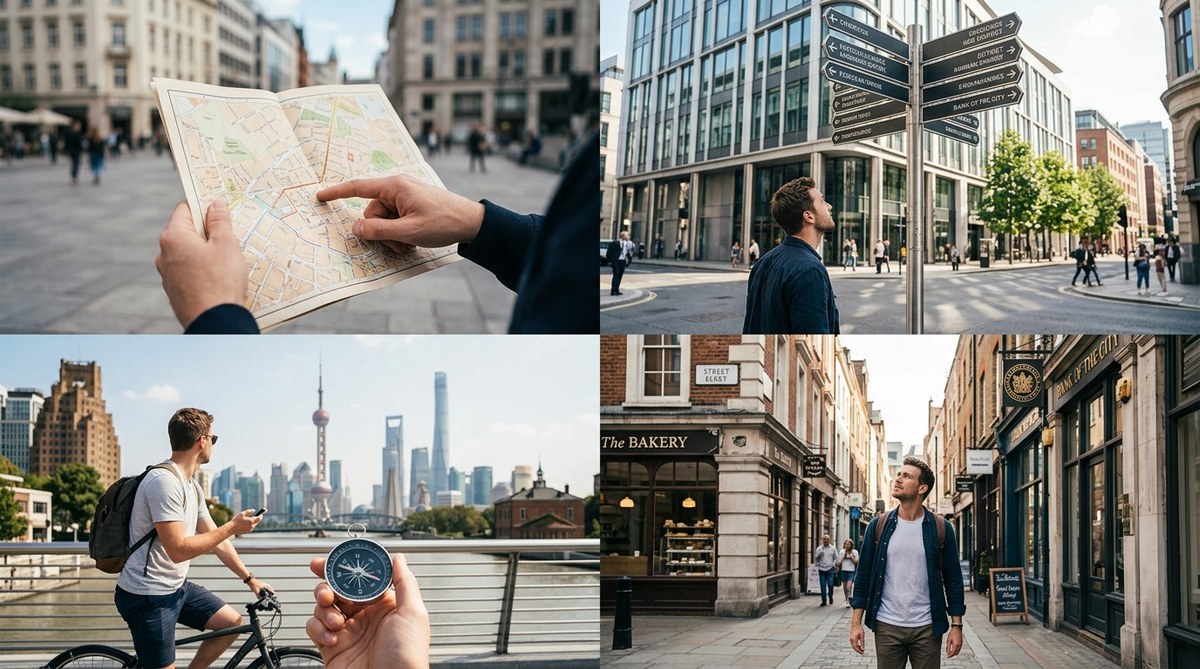
The average American checks their phone 96 times a day. For many of us, that reflexive reach happens most often when we are lost, unsure, or standing at an unfamiliar intersection trying to figure out which way to go. But here is the truth: your phone is not the only tool that can get you where you need to be. In fact, relying on it too much can actually weaken your natural sense of direction. Learning to find your way without a phone is not just a party trick. It is a skill that builds confidence, sharpens your mind, and frees you from the anxiety of a dead battery or a lost signal. Whether you are a hiker on a remote trail, a traveler in a new city, or someone trying to break the habit of reaching for a screen every time you feel disoriented, these techniques will help you navigate the world on your own terms.
In a world where we rely on GPS for every turn, the ability to find your way without a phone is a skill worth reclaiming. This guide covers four practical techniques: reading landmarks, using the sun and shadows, following urban patterns, and building mental maps. These methods work whether you are hiking a trail or walking through a city. Start with one technique today and gain confidence to navigate anywhere without looking at a screen.
Why Your Phone Holds You Back
Think about the last time you used GPS to get somewhere. Did you remember the route afterward? Most people cannot. When you outsource your navigation to a phone, your brain stops paying attention. You stop noticing street names, building shapes, the position of the sun, or the flow of traffic. Your spatial memory fades from lack of use.
This has a name: cognitive offloading. It is the reason you can drive to a friend’s house for years using GPS and still not know how to get there without it. The good news is that your brain is plastic. It can rebuild those skills with practice. And the first step is simply putting the phone down.
Technique 1: Read the Land Like a Local
Every place has a visual language. The trick is learning to read it. When you enter a new area, stop for sixty seconds and look around with intention. Ask yourself three things:
- What are the tallest or most visible structures?
- Which direction does the main street run?
- Where is the sun right now?
These three observations will anchor you. In most U.S. cities, downtown areas have taller buildings. Main streets often run north-south or east-west. The sun gives you a general compass bearing. Together, these clues create a mental scaffold you can hang everything else on.
Landmarks That Actually Work
Not all landmarks are useful. A chain coffee shop looks the same everywhere. Instead, look for unique features: a water tower, a church steeple, a bridge with a distinctive color, a statue in a park, or a building with unusual architecture. These are the anchors that locals use.
When you spot a good landmark, give it a name in your head. For example, “the red brick church with the green roof.” Then note where it sits relative to your path. Is it ahead of you, behind you, to your left, or to your right? This simple mental note can save you from circling the same block three times.
To go deeper, check out our guide on developing natural wayfinding skills in urban environments. It covers how to train your eye to spot the details that matter most.
Technique 2: Use the Sun and Shadows as Your Compass
The sun is the oldest navigation tool in human history. And it still works perfectly, even in a world full of skyscrapers and GPS satellites.
Finding Direction During the Day
In the Northern Hemisphere, the sun rises in the east and sets in the west. At noon, it sits due south. This is not approximate. It is astronomically precise. If you know the time of day, you can estimate your heading with surprising accuracy.
Here is a practical process you can use anywhere:
- Look at the sun’s position in the sky.
- Note the current time. If it is morning, the sun is in the eastern half of the sky. If it is afternoon, it is in the western half.
- Point your left shoulder toward the sun before noon. You are now facing north. Point your right shoulder toward the sun after noon. You are also facing north.
- Check your shadow. A short shadow means the sun is high and it is near noon. A long shadow means the sun is low and you are closer to sunrise or sunset.
- Confirm your direction by walking a short distance and seeing if the sun’s angle changes as expected.
Shadows Tell a Story
Shadows are even more reliable than the sun itself, because you do not have to look directly at the light. In the morning, shadows stretch toward the west. In the afternoon, they stretch toward the east. At noon, shadows are very short and point north.
In a city, pay attention to which sides of the street are shaded and which are lit. If the north side of a street is in shadow and the south side is bright, you know the street runs east-west. If both sides are lit equally, the street runs north-south.
For a deeper look at this technique, read our post on using shadow patterns and sun position for city navigation. It includes tips for cloudy days and high-rise districts.
Technique 3: Follow the Urban Rhythm
Cities have patterns. Streets follow grids, curves, or spokes. Traffic flows in predictable ways. Foot traffic clusters around transit hubs, markets, and public squares. Once you learn to read these patterns, you can navigate without a map.
Street Grid Logic
Most U.S. cities use a grid system. Streets run north-south or east-west. Avenues might run diagonally. If you can figure out the naming convention, you can estimate addresses without looking at a sign. For example, in many cities, numbered streets run one direction and named streets run the other.
If the grid breaks, look for the nearest major thoroughfare. Major roads almost always lead to downtown or to a highway. Follow them, and you will find a landmark you recognize.
Sound and Scent as Cues
Your ears and nose can guide you better than you think. Train horns, highway noise, church bells, and waterfront activity all have distinct sounds. If you hear a train, you know which direction the tracks run. If you smell saltwater or a river, you know which way the coast or waterway lies.
Markets, bakeries, and food carts create scent corridors. In a dense city like New York or San Francisco, these sensory clues can tell you exactly which neighborhood you are in. Our article on urban navigation using sounds, smells, and visual cues breaks down how to train these senses.
Watch the Crowd
Foot traffic follows logic. In the morning, crowds move toward business districts. In the evening, they move toward residential areas and transit stations. If you are lost, follow the flow. It will eventually lead you to a train station, a bus depot, or a main square where you can reorient.
Technique 4: Build a Mental Map Before You Move
The most effective way to find your way without a phone is to build a mental map before you even step out the door. This is not about memorizing every street name. It is about understanding the shape of the area you are entering.
How to Build a Mental Map in 5 Steps
- Look at a paper map or a posted city map for two minutes. Focus on the major roads, rivers, parks, and landmarks. Ignore the small streets.
- Close your eyes and draw the shape in your mind. Trace the main roads with your finger in the air. Picture where the sun will be relative to your route.
- Identify three anchor points. These are places you can see from far away: a tall building, a bridge, a hill, or a water tower. Commit them to memory.
- Note the cardinal directions. Which way does the main street run? Where is north? If you know north, you know everything else.
- Walk the route in your imagination. Picture yourself starting at point A, passing each landmark, and arriving at point B. Repeat this mental walk three times.
This process takes less than five minutes. But it activates the same neural pathways that GPS bypasses. Over time, your brain gets faster at building these maps.
For more on this skill, see our guide to using environmental cues for accurate urban wayfinding in 2026. It covers how to layer multiple cues for maximum accuracy.
Techniques at a Glance
The table below summarizes each technique, what it works best for, the key skill required, and the most common mistake people make when using it.
| Technique | Best Environment | Key Skill | Common Mistake |
|---|---|---|---|
| Reading Landmarks | Cities, towns, suburbs | Observation | Picking generic buildings |
| Sun and Shadows | Any outdoor area | Time awareness | Forgetting seasonal shifts |
| Urban Rhythm | Dense cities | Pattern recognition | Ignoring street layouts |
| Mental Maps | Unfamiliar areas | Memory and recall | Skipping the prep step |
A Word on Practice
These skills do not come back overnight. Your brain has spent years relying on a screen. Rebuilding your internal compass takes repetition. But the payoff is real.
“Navigation is not about knowing where you are at every moment. It is about knowing how to find your way back when you get turned around. That confidence changes how you move through the world.” — old saying among search and rescue volunteers, still taught in wilderness training courses.
Start small. Leave your phone in your pocket on your next walk to the grocery store. Notice the landmarks. Feel the sun on your face. See if you can guess the direction of your street before you turn the corner. These mini challenges rebuild your skills one step at a time.
Why This Matters More in 2026
We are more connected than ever, and more dependent on our devices for basic tasks. Phone addiction is real. The average screen time in the United States has climbed every year. Many people report feeling anxious when they cannot check their phone for directions. That anxiety is a sign that you have outsourced too much.
Learning to find your way without a phone is not about rejecting technology. It is about reclaiming your autonomy. It means you can hike a new trail, visit a foreign city, or simply take a different route home without needing a screen to tell you where to go. It means your phone becomes a tool you use by choice, not a crutch you rely on by habit.
Our pillar guide on finding your way without looking at your phone brings all of these techniques together with additional tips for staying oriented in any situation.
Start With One Technique Tonight
You do not need to master all four at once. Pick the one that feels most natural to you. If you are a visual person, start with landmarks. If you spend time outdoors, start with the sun and shadows. If you live in a big city, start with urban rhythm. If you like planning ahead, start with mental maps.
Practice it for one week. Then add a second technique. Within a month, you will notice a shift. You will look up more and look down less. You will remember routes. You will feel a quiet confidence when you step into an unfamiliar place.
That is the real reward. Not just finding your way, but knowing that you can.