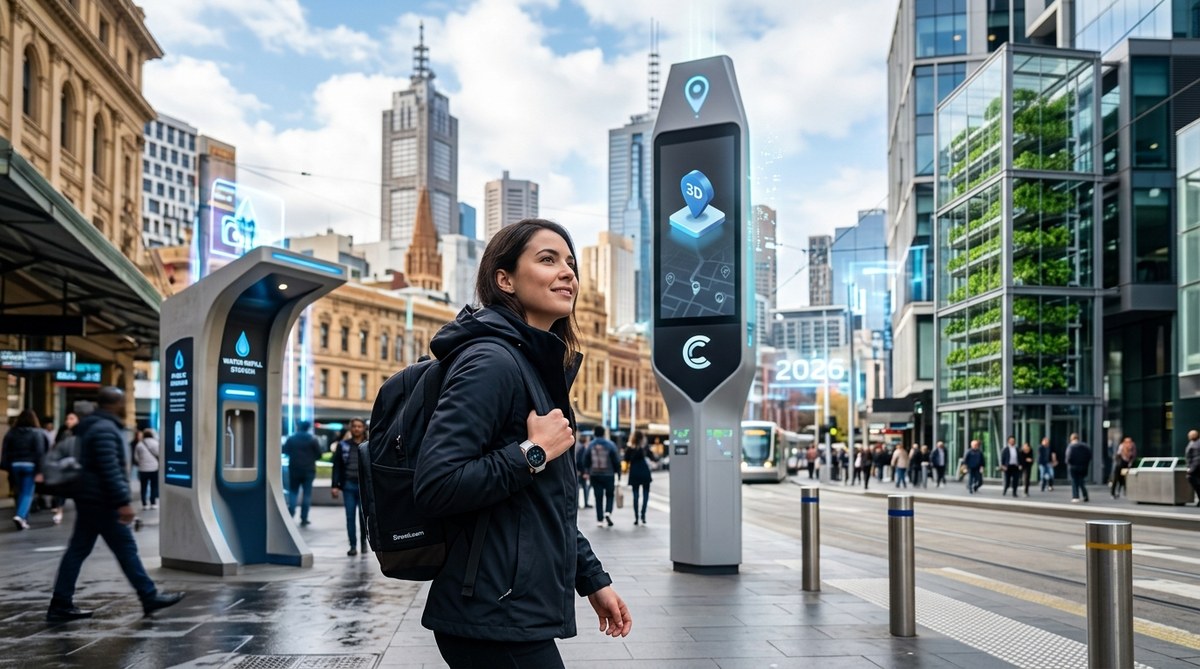
Your phone battery hits zero in a city you have never visited. The GPS is dead. Panic does not need to follow. For years, we have outsourced our sense of direction to a little chip, but the human brain is wired to read the environment. In 2026, urban landmarks navigation is reviving that ancient skill. You do not need a famous tower or a cathedral to orient yourself. The most reliable guides are hiding in plain sight: a faded mural, a patterned manhole cover, the glow of a diner sign at dusk. These unconventional markers are more durable than any app and more personal than any map.
Urban landmarks navigation works best when you shift from seeking obvious monuments to noticing small, repeatable cues. Street art, public utility covers, and distinctive signage form a mental grid that stays reliable even without phone service. This guide gives you three landmark types and a step by step process to build your own inner compass for any American city.
Why the Wrong Landmarks Lead You Astray
Most people assume that a giant skyscraper or a famous statue will keep them oriented. In reality, those big landmarks are often useless for fine grained navigation. A skyscraper may be visible from a mile away, but once you are in the maze of side streets, it disappears behind other buildings. The same statue looks different from every angle. What you need are landmarks that appear at human scale, repeat at consistent intervals, and change just enough to mark location.
Conventional guides like a bronze monument or a plaza fountain rarely help you decide whether to turn left or right. Unconventional urban landmarks, on the other hand, are scattered across every city block. They are cheap to create, easy to remember, and surprisingly permanent.
Three Unconventional Urban Landmarks That Work Every Time
1. Street Art and Murals
Street art is not just decoration. It is a distributed navigation system. In cities like Miami, Denver, and Austin, large scale murals appear on the sides of buildings at key intersections. They are unique enough to serve as waypoints, and unlike a generic bank branch, they are impossible to confuse.
- Each mural has a distinct color palette and theme.
- They often mark the boundary between neighborhoods.
- Locals use them in directions: “turn left at the octopus mural, then right past the butterfly wall.”
When you see a mural, you can instantly confirm you are on the right path. If the mural is familiar, you know your location. If it is new, you have wandered into a different district. This works even in cities that lack a grid system, like Boston or San Francisco.
2. Manhole Covers and Utility Access Points
It sounds strange, but the ground beneath your feet holds a secret map. Many American cities have custom manhole covers that feature the city seal, a historical crest, or a decorative pattern. These are incredibly durable and rarely changed. If you notice a manhole cover with a particular design, you can associate it with a specific area.
- In Chicago, manhole covers near the Loop have one pattern, while those in Wicker Park have another.
- In Philadelphia, covers stamped “City of Brotherly Love” appear only in Center City.
- In Portland, Oregon, some covers incorporate a forest motif, a nod to the nearby parks.
By glancing down every few blocks, you build a mental catalog. The change in pattern signals that you have crossed a neighborhood boundary. This is especially useful when you are underground or in a subway system that uses identical tile work. The manhole cover acts as a breadcrumb.
3. Distinctive Signage and Neon Lights
Signage is the most personal landmark of all. Chains have standardized logos, but independent businesses often display custom signs that are impossible to miss. A glowing pink taco, a revolving barber pole, a hand painted bakery sign. These are not just advertisements; they are navigation anchors.
- In Las Vegas, the historic “Welcome to Fabulous Las Vegas” sign is obvious, but smaller signs like the Atomic Liquors neon clock or the Pawn Plaza sign can guide you through downtown.
- In New York City, the neon “Cup & Saucer” at the Midtown diner has helped tourists find their hotel for decades.
- In Los Angeles, the iconic “Chateau Marmont” sign sits at a curve in Sunset Boulevard, marking the border between West Hollywood and Hollywood.
When you memorize a few local signs along your route, you can orient yourself even without a street map. The signs are lit at night, so they work 24 hours a day.
A Simple Three Step Process for Urban Landmarks Navigation
Here is a practical method to use these markers on your next trip.
- Pick one anchor landmark before you leave your starting point. It could be a mural on the corner of your hotel street, a distinctive sign across from the coffee shop, or a manhole cover at the bus stop. Study its details for ten seconds. Then move.
- Identify a sequence of three to five landmarks along your path. Do not try to remember every detail. Focus on the most unusual feature: the color, the shape, the text. For instance, your path might be: the blue whale mural, the red and white barber pole, the green and gold manhole cover, and finally the neon guitar sign.
- Reverse the sequence to return. When you need to go back, the landmarks appear in the opposite order. This is called “place recognition” and it uses the same part of the brain that remembers faces. It is far more reliable than counting street names.
Practice this on a short walk near your home before you try it in an unfamiliar city. Within a week, you will start noticing landmarks that you have walked past for years.
Common Pitfalls and How to Avoid Them
| Mistake | Why It Fails | Better Approach |
|---|---|---|
| Relying on a single landmark (e.g., “I will just find the tall building”) | One landmark is not enough; it gets blocked or looks similar from different angles. | Use three to five landmarks in a chain. |
| Memorizing generic features (e.g., “a red brick building”) | Too many buildings look the same. | Focus on unique details: a broken window, a specific sign, a painted door. |
| Trusting temporary landmarks (e.g., “the food truck with the green awning”) | Food trucks move, seasonal decorations change. | Choose permanent markers: murals bolted to walls, metal signs, cast iron covers. |
| Ignoring the ground | You miss half the available cues. | Scan at your feet as often as you scan the skyline. |
How to Train Your Eye for Unconventional Landmarks
You do not need to be a cartographer. Start by walking a familiar route with the intention of noticing three street art pieces, three unique signs, and three manhole covers. Write them down or take a picture. The next day, try to retrace the route without the photos. You will be surprised how much you recall.
As you get comfortable, expand to other cities. The same principles apply whether you are in New Orleans with its cast iron balconies and custom drain covers, or in Seattle with its painted electrical boxes and coffee shop logos. The culture of the city is encoded in these details.
Blockquote example:
“The best navigators do not look at the horizon. They look at the curb, the wall, the window. That is where the real map is written. Street art and utility covers are the unsung heroes of wayfinding because they are both local and permanent.”
Ramon Costa, Urban Geographer and founder of the City Signals Project
Cross Referencing Landmarks with Natural Cues
Unconventional landmarks become even more powerful when you pair them with the sun or wind direction. If you know that the sun sets in the west, and you see a mural of a blue whale facing east, you can deduce that you are heading north along the east side of the street. This combination gives you a sense of cardinal direction without a compass.
For a deeper look at using sunlight and shadows, check out this guide on how to use urban shadows and light to find your way in any city. It complements the landmark technique perfectly.
Building a Mental Atlas for Any Trip
Before your next vacation, spend ten minutes on Google Street View. Look for street art, distinctive signs, and manhole covers along the route from your hotel to the nearest subway stop. Save a mental snapshot of two or three items. When you arrive, those items will act as instant anchors.
If you are traveling to a city that leans heavily on a grid, like Chicago or Washington D.C., the landmarks help you confirm the grid rather than disrupt it. They are the texture that makes the grid memorable.
For a full system of environment based wayfinding, read my article on mastering urban navigation techniques without using a map. It shows how to layer sound and scent cues on top of the visual landmarks.
Why Your Old Tricks Might Not Work in 2026
Cities are changing. Public art programs are expanding, and many municipalities are commissioning unique manhole covers for historic districts. Meanwhile, chain stores are standardizing their signage. The result is that unconventional landmarks are becoming more common while generic landmarks become less useful. The traveler who adapts will have an edge.
The same skills apply whether you are walking, biking, or taking public transit. They also work when you are driving, as long as you can safely notice. But for the best practice, leave the car at home and walk.
A Warm Invitation to Go Offline
The next time your phone battery drops below twenty percent, smile instead of stress. You now have a new set of tools. Look for the mural that catches your eye. Spot the manhole cover with the city seal. Notice the neon sign that glows differently from the rest. These are your guides, and they have been waiting for you to see them.
Try it today. Take a fifteen minute walk in your own neighborhood using only the landmarks you discover. No phone, no map. Just your eyes and your memory. You will feel a sense of freedom that no app can provide. And when you travel, you will walk with the confidence of a local, even on your first day.
For more exercises like this, read how to develop your urban senses for seamless city navigation in 2026. It includes drills for sound, smell, and touch that work alongside the visual cues you have learned here.
Now go out and get lost on purpose. You know how to find your way back.