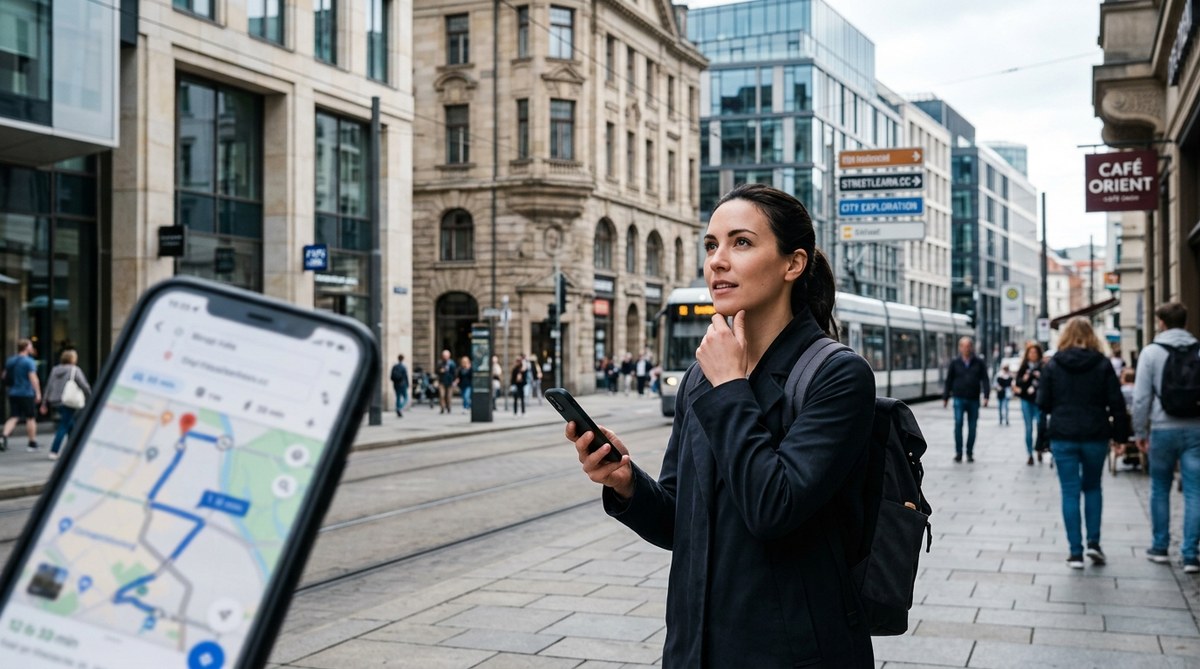
You pull into a parking lot in a neighborhood you have visited a dozen times. But without looking at your phone, you cannot figure out which direction the grocery store entrance faces. Sound familiar? That is what happens when your smartphone is ruining your sense of direction. Day after day, GPS does the thinking for you. Your brain’s internal compass slowly goes quiet. By 2026, most adults in the U.S. admit they struggle to find their way without a map app. The good news is that you can reverse the damage. Your navigation skills are not gone. They are just out of practice.
Smartphones weaken your hippocampus by outsourcing navigation decisions. The brain stops building mental maps when a blue dot does the work. This leads to poorer spatial memory, reduced landmark recall, and increased anxiety without GPS. Fix it by practicing dead reckoning, using landmarks, and gradually reducing turn-by-turn directions. Start with one trip a week without your map app.
Why your phone is making you lost
The problem is not that maps are bad. The problem is that your phone does too much. When you follow a blue line and listen to “turn left in 200 feet,” your brain never has to track where you are relative to the terrain. Neuroscientists call this cognitive offloading. Your hippocampus, the part of the brain that stores spatial maps, gets less and less exercise. Over time, it shrinks.
A 2020 study from University College London found that people who used GPS more had poorer spatial memory when tested without it. They also showed less activity in the hippocampus. By 2026, the average American adult has spent years relying on phones. That means a generation of people who can navigate a screen but not a city.
The real cost: losing your mental map
Without a mental map, you lose more than just the ability to find a coffee shop. You lose the sense of place. You stop noticing street names, building shapes, sun direction, and shadows. You do not remember the corner where the bakery used to be or the way the wind blows through a certain block. That kind of knowledge is not decorative. It is what makes a city feel like home.
Here is a simple exercise. Next time you step out of a subway station, look at your phone to see which way is north. Then put the phone away. Try to point north again two blocks later. Most people cannot do it. That is your brain telling you it has outsourced the compass.
How to rebuild your navigation skills (numbered list)
You can retrain your brain. It takes a few weeks, but the results are lasting. Follow these steps in order.
- Turn off turn-by-turn voice guidance. Keep the map visible but silence the spoken directions. This forces you to look at the route and make decisions yourself. You still have a safety net, but your brain has to process the layout.
- Look up before you walk. Spend 30 seconds scanning the skyline. Identify three landmarks, one per direction. A water tower, a tall building, a church spire. Link each one to a direction. You can use these mental anchors later when you feel disoriented.
- Walk one block without checking your phone. Then guess which way you need to go next. Unlock your phone only to confirm. Over a week, increase that to two blocks, then three, until you can navigate a mile without looking at the screen.
- Draw a map from memory after a walk. Use a piece of paper or a notes app. Sketch the streets you took and the places you passed. Do not peek at the actual map until you finish. This strengthens the hippocampus.
- Practice one “no phone” trip per week. Choose a familiar destination, like the grocery store or a friend’s house. Leave your phone in your bag or pocket. Use only memory and landmarks. If you get lost, ask a stranger. That alone rebuilds confidence.
Common GPS mistakes and better habits (markdown table)
| What most people do | What you should do instead |
|---|---|
| Start the route before leaving the driveway | Study the route on the map first, then put the phone away until you need a check |
| Stare at the phone while walking | Glance at the phone only at intersections or turns |
| Use “arrival time” as a crutch | Estimate your own arrival time based on pace and distance |
| Never look behind you | Turn around periodically to memorize what the street looks like in reverse |
| Rely on the same app always | Switch to a paper map or a compass app that shows coordinates only |
| Let the phone choose the parking spot | Park somewhere new on purpose and remember the location without a pin |
Stop doing these things (bullet list)
- Do not zoom in on the map while walking. It kills your sense of scale.
- Do not follow the blue dot blindly. If you see a shortcut that looks faster, take it and see if you can get back on track.
- Do not use the “recents” tab to find your way back to a place. Try to retrace your route from memory.
- Do not let the phone recharge your navigation every time. Give yourself a chance to hesitate and figure it out.
- Do not ignore the sun. Even in cloudy weather, you can tell where the light comes from.
What the experts say
“The hippocampus is like a muscle. If you stop using it for spatial tasks, it gets weaker. Using GPS three times a week is enough to start seeing a decline in your ability to form cognitive maps. The fix is to give your brain small challenges regularly. Walk without a phone once a week, and you will notice a difference in six months.”
— Dr. Veronica Lang, cognitive neuroscientist specializing in spatial navigation at Stanford University
A simple weekly plan to rewire your brain
Monday: Study a printed map of your neighborhood for five minutes. Memorize the major streets and the direction of the nearest river or highway.
Wednesday: Walk to a nearby coffee shop without your phone. If you get lost, use a storefront sign or ask someone. Do not pull out the phone.
Friday: On your commute, turn off the GPS voice. Look at the map only twice during the trip.
Sunday: Go somewhere you have never been. Use your phone to get within three blocks. Then turn it off and find the exact address using only visual cues.
If you want more structured practice, check out these related guides: Master urban navigation techniques without using a map and top tips for developing natural wayfinding skills in urban environments.
The hidden benefit of getting lost
When you stop relying on your phone, you start noticing more. You see the mural on the side of the laundromat. You hear the street musician at the corner. You smell the bread from the bakery two blocks away. Your brain starts building a richer map of the city. That is not just good for navigation. It is good for memory, creativity, and connection to place.
One final truth about your smartphone and sense of direction
Your phone is a tool, not a replacement for your own brain. You can still use GPS when you are in a hurry or in a completely unfamiliar city. But the rest of the time, give your hippocampus the workout it needs. Start small. One trip without the blue line. One glance at the sun. One moment of uncertainty you solve yourself.
You will not get lost forever. You will get found. And you will carry a map in your head that no battery can drain.