You step off the train in a city you have never seen before. The street signs are in a different language. The grid is unfamiliar. Your phone battery is at 15 percent. In that moment, your brain tries to do something remarkable: it begins to build a mental map. The problem is, most people never train this skill. By the time they find their hotel, they have already forgotten the route. But what if you could learn to construct mental maps for cities before you even arrive? That skill is not just for taxi drivers or park rangers. It is for anyone who wants to feel at home the moment they land. In 2026, with travel busier than ever, building a strong mental map of a city is the secret to moving through it like a local.
Mental maps are not a natural gift. They are a skill you can practice. By focusing on five specific maps (transit, landmarks, grid, neighborhoods, and sensory cues) you can build a reliable internal navigation system for any city. Start before your trip and reinforce it during your visit. No GPS required.
What Are Mental Maps for Cities?
A mental map is your brain’s own version of Google Maps. It stores the relationships between places, streets, and landmarks in a way that lets you move without needing a screen. When you think of your hometown, you can probably picture the fastest route from your house to the grocery store without looking anything up. That is a mental map.
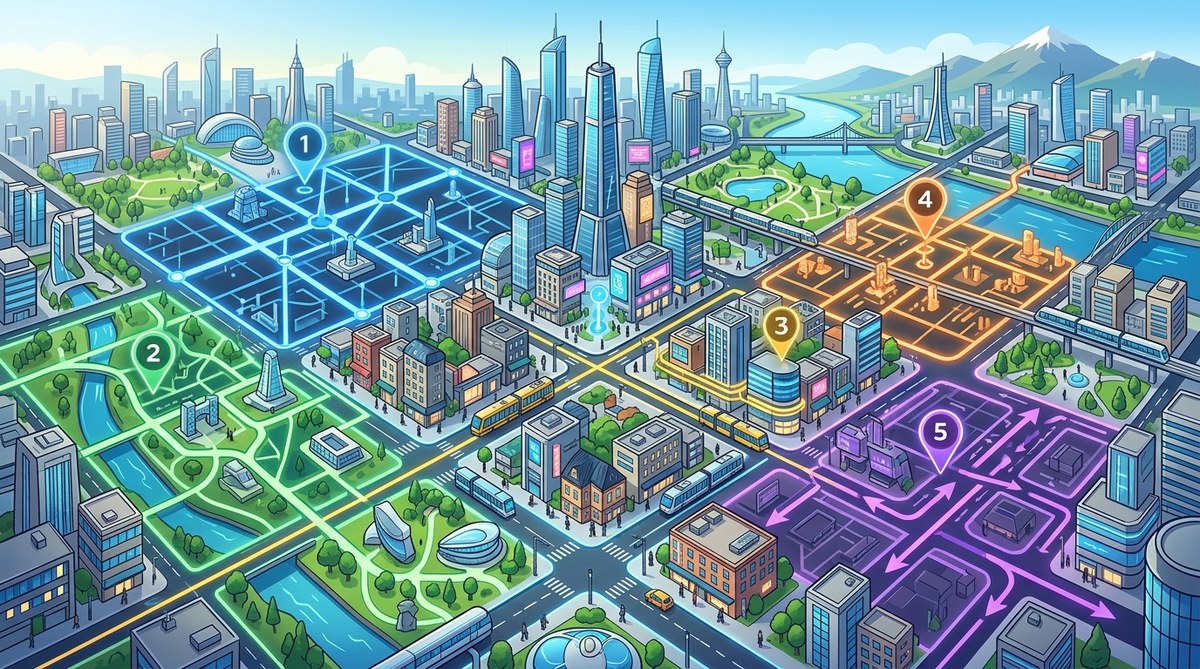
For a new city, your mental map starts blank. But you can fill it faster than you think. The goal is not to memorize every street name. The goal is to build a flexible mental framework that lets you reorient yourself when you get turned around. As the city planner Kevin Lynch wrote in his book The Image of the City, people navigate using five elements: paths, edges, districts, nodes, and landmarks. You can think of those as the building blocks of your own mental maps for cities.
Why Build Mental Maps? The Real Benefits
- Save time and energy. You stop relying on your phone for every turn. Your eyes stay on the street, not the screen.
- Reduce anxiety. When you understand the shape of a city, you feel less lost. Even a wrong turn feels like an adventure.
- Deeper connection to the place. Noticing how neighborhoods change, where the sun hits, and which streets feel busy gives you a richer experience.
- Safety in low-tech moments. Dead battery? No signal? Your mental map works anywhere.
- Better spatial memory over time. Like any muscle, your brain gets stronger the more you practice this skill.
If you want to take this further, check out master urban navigation techniques without using a map. It builds on the same principles.
The 5 Mental Maps You Need for Any City
These are the five mental maps that frequent travelers and urban explorers rely on. Each one covers a different layer of the city. Together, they give you a complete picture.
-
The Transit Map
Before you arrive, study the skeleton of the city’s public transport system. You do not need to memorize every stop. But know the main lines, their direction (north-south vs. east-west), and the central transfer stations. For example, in New York, the A train runs mostly up the west side, while the 4 and 5 go up the east side. In London, the Circle Line roughly traces the inner core. This mental map gives you a framework for distance and orientation. -
The Landmark Map
Pick three to five major landmarks that are spread across the city. A famous tower, a river, a big park, a historic square. These become your anchor points. When you are lost, you can always walk toward a landmark. Over time, you start to learn how these landmarks relate to each other. For deeper guidance, read learn to navigate any U.S. city using only your senses and landmarks. -
The Grid Map
Most cities have some kind of street pattern. It may be a perfect grid like Chicago or Portland, or a more organic layout like Boston. Even in chaotic cities, there is usually a logic. The grid map captures the main arteries, the numbering system, and the direction of one-way streets. Once you understand the grid, you can estimate travel time without consulting an app. -
The Neighborhood Map
Cities are collections of villages. Each neighborhood has a character, a center, and borders. In Paris, the 10th arrondissement feels different from the 6th. In Tokyo, Shibuya and Shinjuku are worlds apart. Build a mental map of which neighborhoods connect to which. This helps you plan walks and avoid accidentally wandering into a residential area late at night. For more on this, see top strategies for navigating cities intuitively in the digital age. -
The Sensory Map
This is the most personal mental map. It uses sounds, smells, light, and even temperature. The smell of bread from a bakery tells you you are near a market. The sound of a subway grate means a station is close. The direction of shadows tells you which way is south. Developing this map takes practice, but it is incredibly reliable. For example, in many cities, the prevailing wind comes from a certain direction. Using that as a cue can keep you oriented.
How to Practice Building Mental Maps
Below is a table that shows common techniques and the mistakes people make when they try to build mental maps for cities.
| Technique | What to Do | Common Mistake |
|---|---|---|
| Preview the city from above | Pull up a satellite view on your laptop before your trip. Study the river, the major roads, and the park system. | Trying to memorize every street. Instead, focus on the big shapes. |
| Take a walking tour the first day | Join a free walking tour to see the main landmarks in context. Your brain will start linking them together. | Following the tour guide blindly without looking around. Pay attention to the route. |
| Draw the map from memory | At the end of each day, sketch the parts of the city you visited. Don’t worry about accuracy. The act of drawing strengthens spatial memory. | Erasing and correcting too much. Let the sketch be messy. The mistakes teach you. |
| Use cardinal directions | Always note whether a street runs north-south or east-west. Even in a car, check the position of the sun. | Relying on “left” and “right” only. That is useless when you rotate. |
| Visit the same place from different angles | Walk to the same landmark using three different routes. This builds a web of connections. | Always taking the same path. Your mental map stays flat. |
If you need more structured practice, read top 7 tips for improving your spatial awareness in any city. It offers exercises you can do in any urban environment.
Expert Advice: The Power of Repetition
“Mental maps are not built in a single day. They come from repeated exposure. Each time you walk a street, you reinforce the neural connections. The trick is to do it intentionally. Instead of letting your GPS guide you, choose a landmark and try to find it by memory. Even if you fail, you learn something about the city’s layout.”
— Based on research in cognitive geography by Dr. A. K. Golledge, author of “Human Wayfinding and Spatial Cognition”
This is why frequent travelers often seem to know a city after just one weekend. They are not smarter. They are practicing a skill.
Put Your Mental Maps to Work in 2026
The best time to start is before your next trip. Choose one of the five maps above and focus on it. Maybe it is the transit map. Spend twenty minutes looking at a schematic. Then close the image and draw it from memory. Repeat until you can recall the main lines without thinking.
On your first day in the city, make a game of it. Try to navigate from the airport to your hotel using only your mental transit map. If you get lost, that is fine. Each mistake fills in your map. By the end of the trip, you will have a mental model of the city that will last for years.
For those who want to go deeper, there are many resources. Consider mastering urban wayfinding techniques for confident city navigation in 2026. And if you are ever in a situation where your phone dies, you will be glad you practiced.
Building mental maps for cities is not a secret talent. It is a habit. Start today, and your next trip will feel completely different. You will walk out of the station not with a map in your hand, but with one in your head.