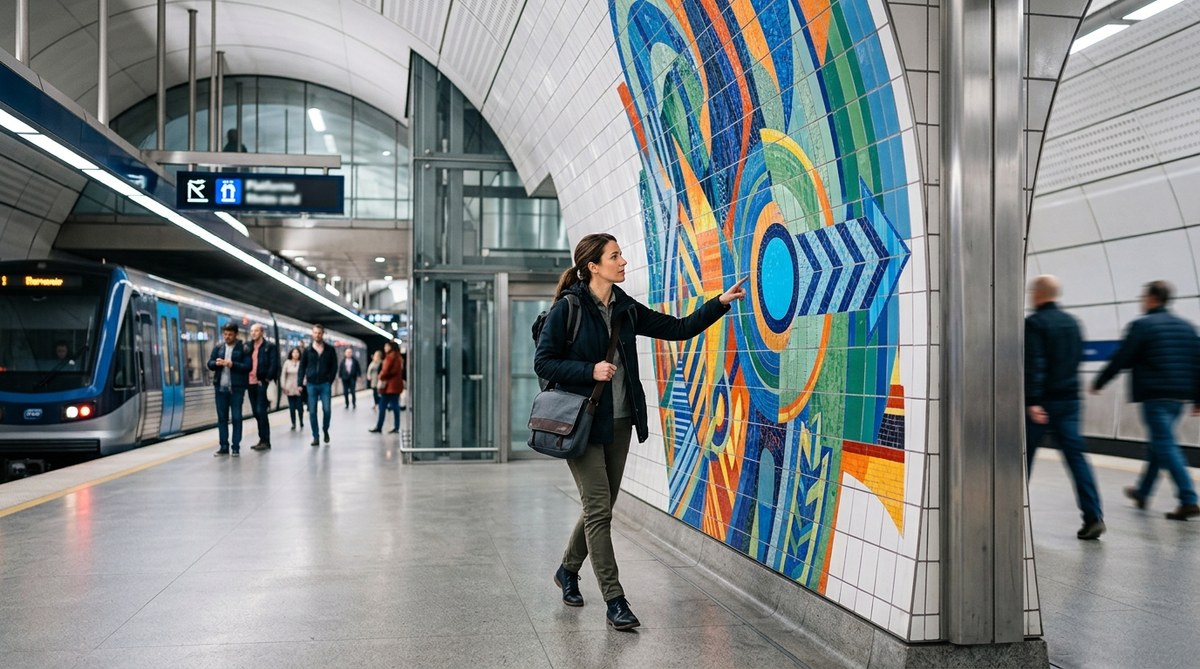
You step off the train and into a station that all look the same. White tiles. Fluorescent lights. The same signs you have seen a hundred times. Your phone says you need to go north, but you are not sure which way that is underground. Then you spot it. A giant mosaic of a whale swimming across the wall. You remember that the whale is near the downtown exit. Suddenly you know exactly where you are.
That is the power of subway art navigation. Public art in transit systems is not just decoration. It is a mental map waiting to be used.
Subway art works as a natural navigation system because your brain remembers images better than text. By treating murals, sculptures, and tile patterns as landmarks, you can build a mental map of any city’s subway system. This guide shows you how to use subway art navigation to improve your spatial awareness and move through stations with confidence.
Why Your Brain Loves Art More Than Signs
Your brain processes images faster than words. This is called the picture superiority effect. When you see a sign that says “Exit 42nd Street,” your brain has to read it, translate it, and recall the layout. When you see a bright red sculpture of a bird, your brain registers the shape and color instantly.
Subway art navigation works because public art creates unique visual anchors. Every station starts to feel different. You stop relying on tiny text and start using your eyes.
Think about how you remember a friend’s apartment. You probably do not think of the street number first. You think of the red door or the big plant in the window. Subway art works the same way.
What Makes a Good Art Landmark
Not all art works equally well for navigation. Look for pieces that are:
- Large and easy to spot from a distance
- Brightly colored or high contrast
- Placed near decision points like stairs, platforms, or exits
- Unique to that station
A small plaque on the wall will not help you. A floor-to-ceiling mural of a city skyline will stick in your memory for years.
How to Use Subway Art Navigation in Three Steps
You can start using this technique today. Here is a simple process to follow the next time you ride the subway.
-
Pick one piece of art per station. When you enter a new station, scan the walls for the most noticeable artwork. It could be a mosaic, a sculpture, or even a patterned tile floor. Take five seconds to notice the colors and shapes.
-
Assign a direction to the art. Look at where the art is located. Is it near the uptown stairs? The downtown platform? The exit to the west side? Silently tell yourself: “The blue fish means I am near the south exit.” You are building a mental link between the art and a spatial direction.
-
Use the art as a checkpoint. As you walk through the station, glance back at the art. Confirm that you are still heading the right way. If you get turned around, find the art again and reorient yourself.
This method trains your brain to create a mental map. Over time, you will remember stations by their art instead of their names.
What to Look For When You Scan a Station
When you walk into a station, use this bulleted list as a mental checklist:
- Mosaics and tile work on the walls
- Sculptures hanging from the ceiling
- Painted murals on the mezzanine level
- Colored glass panels or windows
- Unique floor patterns or medallions
- Benches or columns that are artistically designed
Any of these can become your anchor. The key is to notice them intentionally.
Common Mistakes People Make
Most people ignore public art because they think it is just decoration. They keep their eyes on their phones and miss the visual cues around them. Here are the three biggest mistakes in subway art navigation, along with the better approach.
| Mistake | Why It Hurts Navigation | What to Do Instead |
|---|---|---|
| Looking at your phone while walking | You miss all visual landmarks | Keep your phone in your pocket until you reach the platform |
| Assuming all stations look the same | You stop looking for differences | Actively search for one unique piece in every station |
| Only reading signs and maps | You rely on text that is easy to forget | Pair the sign with a visual landmark for double recall |
“The best wayfinding systems are the ones you do not notice. Good public art makes you feel oriented without needing to ask for directions.” – Urban design researcher at the Project for Public Spaces
Real Examples of Subway Art Navigation
You can see this technique in action across the United States. In New York City, the 72nd Street station on the Second Avenue Subway features glass panels by artist Chuck Close. The faces are huge and unmistakable. If you are heading to the downtown platform, you pass the large portrait of a woman with blue eyes. That face becomes your cue.
In Washington D.C., the Metro system uses vaulted concrete ceilings that feel like a cathedral. Each station has a different platform shape and column design. The Dupont Circle station has a distinctive circular mezzanine. The art is not just on the walls. The architecture itself becomes the landmark.
In Chicago, the O’Hare station has a colorful neon sculpture called “The Sky’s the Limit.” It hangs over the escalators. You can see it from the train platform. That bright neon piece tells you that you have arrived at the airport stop.
These are not accidents. Transit authorities often place art at decision points. They know that visual anchors help people move through the system.
How to Combine Art with Other Navigation Cues
Subway art navigation works best when you use it alongside other techniques. You can pair art with sound, light, and crowd flow to build a richer mental map.
For example, if you are in a station with a large terrazzo floor pattern, notice how the pattern changes near the stairs. Some stations use different colored tiles to mark the edges of platforms. These are subtle cues that designers added on purpose.
You can also pay attention to the materials. Older stations might have brass railings and marble walls. Newer stations might use glass and steel. Each material gives you a clue about which part of the city you are in.
If you want to go deeper into this skill, check out our guide on mastering urban navigation techniques without using a map. It covers how to layer multiple cues for better orientation.
Train Your Eye in Five Minutes a Day
You do not need to study art history to get better at this. Just start paying attention. On your next commute, pick one station and find three pieces of art or design. Remember them. The next day, see if you can recall them before you enter the station.
Over time, your brain will automatically scan for landmarks. You will start to notice patterns you never saw before. That is the moment when subway art navigation becomes second nature.
For more on building these skills, read our article on top tips for developing natural wayfinding skills in urban environments. It pairs well with the art technique.
What to Do When the Art Is Missing
Not every station has museum-quality art. Some stations are purely functional with plain tiles and concrete. In those cases, look for other visual anchors.
Check for:
- Unique exit signs or station markers
- Different colored columns or beams
- Distinctive storefronts inside the station
- Vending machines or kiosks in unusual spots
- Graffiti or community murals that are not official
Even a broken clock or a missing tile can become a landmark. Your brain will attach to anything that breaks the pattern.
If you are in a city with a very uniform subway system, like the Paris Metro, focus on the station entrance art instead. The famous Art Nouveau entrances are all different. Each one tells you which station you are at before you go underground.
The Future of Subway Art Navigation in 2026
Cities are investing more in public art as a wayfinding tool. In 2026, several transit authorities are adding interactive art that changes based on the time of day or the number of people in the station. These dynamic pieces create even stronger memory anchors.
Some systems are using augmented reality to layer digital art over physical stations. You might point your phone at a blank wall and see a virtual mural appear. That digital art can guide you to your platform.
But the core principle stays the same. Your brain remembers images. The more unique the image, the better your memory.
For a broader look at how to read the city around you, read our guide on how to read the urban environment to navigate without a map in 2026. It covers many of the same principles applied to the street level.
Make Every Station a Landmark
The next time you ride the subway, put your phone away for one stop. Look at the walls. Find one thing that stands out. It could be a tile pattern, a sculpture, a mural, or even the shape of the ceiling. Assign it a direction. Use it as your anchor.
You might feel silly at first. But after a few tries, you will notice that you remember stations better. You will stop second-guessing which exit to take. You will start moving through the system with a calm confidence.
That is the real gift of subway art navigation. It turns a confusing underground maze into a gallery of landmarks that point you home.
Start small. Pick one station on your regular route. Learn its art. Then add another. Before long, you will have a mental map of your entire subway system built entirely from mosaics, murals, and sculptures.
And the best part? You will never look at public art the same way again.