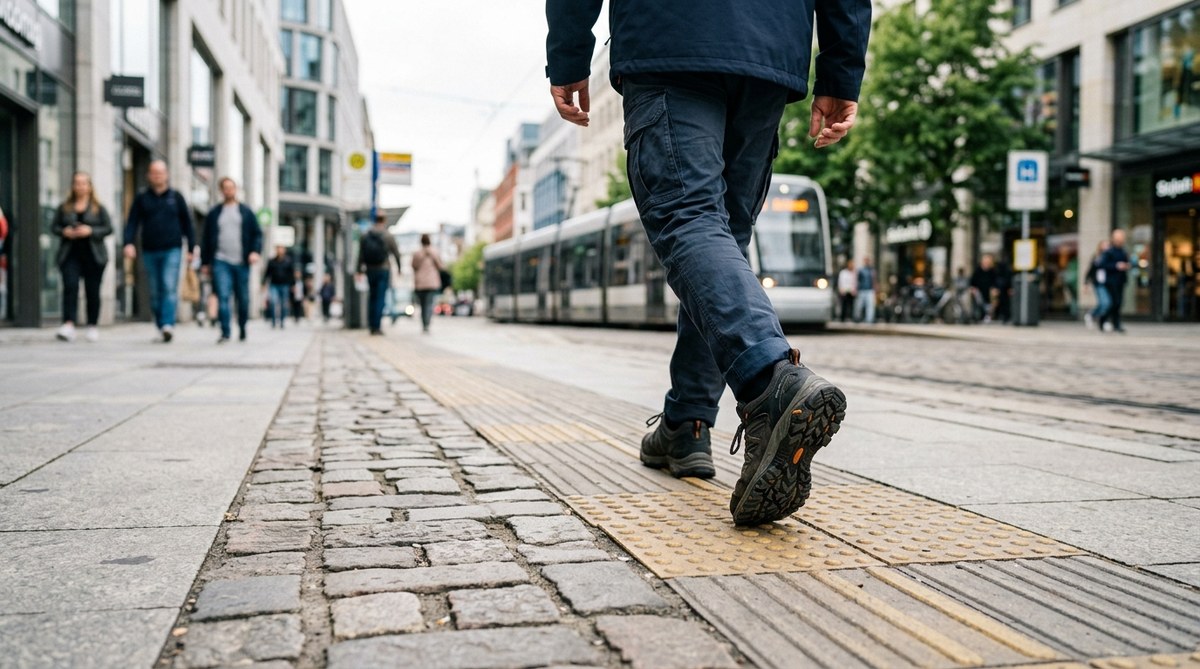
Your feet send signals to your brain that your eyes often miss. When you walk through a city, your soles pick up tiny changes in texture, slope, and temperature. That subtle shift from smooth concrete to rough asphalt? That is a data point. The slight uphill grade on a side street? That is a directional clue. In 2026, more people are rediscovering what pedestrians have always known: your feet are natural navigation tools.
Tactile navigation uses the soles of your feet to detect changes in ground texture, slope, and materials. This skill helps you build mental maps without relying on a phone screen. In 2026, urban designers and accessibility advocates are pushing for better tactile cues in public spaces. You can learn to read these signals today.
What Tactile Navigation Actually Means
Tactile navigation is the practice of using physical sensations underfoot to orient yourself. It is not just for people with visual impairments. Anyone can benefit from this skill. When you feel a rumble strip at a crosswalk, your brain registers a boundary. When your foot lands on a different paving material, you know you have entered a new zone.
Think of it like reading braille with your feet. The ground has a language. You just need to learn the alphabet.
In 2026, cities across the United States are updating their sidewalks to include more tactile cues. These changes are part of a broader push for inclusive design. The Americans with Disabilities Act (ADA) already requires detectable warning surfaces at curb ramps. But now, urban planners are going further. They are adding textured paths, directional grooves, and material changes that help everyone navigate.
Why Tactile Navigation Matters More in 2026
You might wonder why this is gaining attention now. Three reasons stand out.
First, smartphone dependency has reached a peak. People walk into poles, trip over curbs, and miss street signs because they are staring at screens. Tactile navigation offers a way to look up. It puts your attention back on the environment.
Second, accessibility advocacy is stronger than ever. The disability community has pushed for years to make cities more navigable. Their work is paying off. New construction projects in places like Seattle, Austin, and Boston now include tactile paving as standard. That means more textured cues for everyone.
Third, climate resilience is changing how we design streets. More cities are using permeable pavers, which have distinct textures. These materials help manage stormwater but also create unique tactile signatures. Your feet can tell the difference between a permeable paver and standard asphalt.
How to Start Using Tactile Navigation Today
You do not need special equipment. You just need to pay attention. Here is a simple process to begin.
- Find a quiet sidewalk. Start on a street with low foot traffic. Remove your headphones. Put your phone in your pocket.
- Walk slowly and notice textures. Feel the difference between concrete, brick, and asphalt. Notice where one material ends and another begins.
- Map the transitions in your mind. When you reach a corner, note the change in ground material. That becomes a landmark.
- Close your eyes for a few steps. Do this only in a safe space. Let your feet guide you. Notice if you can sense a curb or a slope change.
- Repeat the walk daily. After a week, you will remember the texture sequence. You will know where you are without looking at a sign.
This method builds what experts call a tactile mental map. Your brain stores the feeling of each surface. Over time, you can navigate familiar routes by feel alone.
Common Tactile Cues and What They Mean
Different surfaces send different messages. Here is a breakdown of what to look for.
| Surface Type | Typical Location | What It Signals |
|---|---|---|
| Truncated domes (bumpy yellow pads) | Curb ramps, train platforms | Warning: edge or drop-off ahead |
| Smooth concrete | Main sidewalks | Standard walking path |
| Brick or cobblestone | Historic districts, plazas | Slower pace zone, pedestrian priority |
| Rubberized mats | Crosswalks, transit stops | Anti-slip surface, high traffic area |
| Gravel or crushed stone | Parks, pathways | Informal route, recreational area |
| Grooved or scored concrete | Bike lanes, shared paths | Separation between modes of travel |
Each of these textures tells you something about your surroundings. When you feel truncated domes underfoot, you are near a street crossing. When you step onto brick, you are likely entering a plaza or a pedestrian mall.
Mistakes People Make When Learning Tactile Navigation
It is easy to fall into bad habits. Here are the most common ones.
- Relying only on vision. If you look down constantly, you miss the point. Tactile navigation works best when you let your feet do the seeing.
- Walking too fast. Speed dulls sensation. Slow down to let your soles register the details.
- Ignoring slope. A gentle incline tells you which way is uphill. That can help you orient toward a landmark like a hilltop park.
- Wearing thick, cushioned shoes. Minimalist shoes or thin soles give you more feedback. If you wear heavy boots, you will miss the subtle cues.
- Forgetting about weather. Rain and snow change surface textures. Wet concrete feels different from dry concrete. Adapt your mental map accordingly.
“Your feet are like antennae. They pick up information the rest of your body ignores. The trick is learning to listen to them.” — Dr. Lena Rivas, urban sensory researcher at the University of Oregon
How Cities Are Designing for Tactile Navigation in 2026
Urban design is shifting. Here are the trends shaping tactile navigation this year.
Tactile Wayfinding Systems
Several U.S. cities are installing tactile wayfinding paths. These are continuous textured strips that guide people from transit stops to key destinations. San Francisco has a pilot program in the Mission District. The path uses a combination of ribbed tiles and directional arrows that you can feel underfoot.
Material Zoning
Planners are using different paving materials to define zones. In Portland, Oregon, the downtown core uses a specific brick pattern for pedestrian-only areas. If you feel brick under your shoes, you know cars are not allowed. This reduces cognitive load and increases safety.
Smart Tactile Surfaces
Some new installations include sensors embedded in tactile tiles. These sensors can detect when someone is approaching a crosswalk and trigger audio signals. The surface itself is still textured, but it now communicates with the city infrastructure.
For a deeper look at how cities are incorporating these ideas, read our guide on enhancing your urban navigation skills using environmental cues.
The Connection Between Tactile Navigation and Spatial Awareness
Tactile navigation does not exist in a vacuum. It works best when combined with other sensory inputs. Your feet tell you about the ground. Your ears tell you about traffic and crowds. Your nose can detect coffee shops, bakeries, or construction sites.
When you put all these senses together, you build a rich mental model of your environment. This is called spatial awareness. People with strong spatial awareness can navigate unfamiliar places with confidence. They do not panic when GPS fails. They trust their senses.
You can train this skill. Start by walking a familiar route without looking at your phone. Focus on the feeling of each step. Notice how the ground changes as you approach a crosswalk. Listen for the sound of traffic to confirm your location. Over time, you will develop a kind of internal compass.
For more on building this skill, check out our article on developing your urban senses for seamless city navigation in 2026.
Tactile Navigation for Accessibility Advocates
If you are an accessibility advocate, you already know the importance of tactile cues. But you might not realize how much influence you have. In 2026, advocacy groups are pushing for standardized tactile maps at transit stations. These are raised maps that people can read with their fingers. They show the layout of the station, including platforms, exits, and elevators.
You can advocate for these changes in your own city. Attend city council meetings. Talk to your transit authority. Show them examples from cities that already have tactile maps. The more people demand these features, the faster they will appear.
Another area of focus is tactile signage. Braille signs are common, but they are often placed too high or too low. Advocates are calling for consistent placement at a reachable height. They are also asking for signs that include both braille and raised print, so sighted and non-sighted people can share the same information.
Practical Exercises to Build Your Tactile Skills
You do not need a special class. Try these exercises on your next walk.
- Texture hunt. Find five different surfaces in one block. Name them. Concrete, brick, metal grate, rubber mat, and asphalt. Notice how each one feels.
- Slope detection. Walk a block and identify every change in grade. Uphill, downhill, flat. Use your feet to sense the angle.
- Edge tracking. Walk along a curb without looking. Use the side of your foot to feel where the sidewalk ends. This builds confidence in low visibility.
- Night walk. Walk a familiar route after dark. Use only tactile and auditory cues. You will be surprised how much you already know.
For a more structured approach, read about mastering urban navigation without tech using these essential techniques.
The Future of Tactile Navigation
Looking ahead, tactile navigation will likely become more integrated with technology. Imagine smart shoes that vibrate when you approach a crosswalk. Or tactile tiles that change texture based on weather conditions. These are not science fiction. Prototypes exist today.
But the core skill will remain the same. Your feet are remarkable sensors. They can detect a pebble, a puddle, or a change in pavement density. When you learn to trust them, you gain a freedom that no app can provide.
In a world where screens dominate, tactile navigation is a return to embodied awareness. It is a way to move through cities with presence and confidence.
Your Feet Already Know the Way
The next time you step outside, pause for a moment. Feel the ground beneath your shoes. Notice what it tells you. Is it smooth or rough? Flat or sloped? Familiar or new?
That information is always there. You just have to listen.
Tactile navigation in 2026 is not a trend. It is a return to a basic human skill. One that helps you stay safe, stay present, and stay connected to the world around you. Start practicing today. Your feet will thank you.