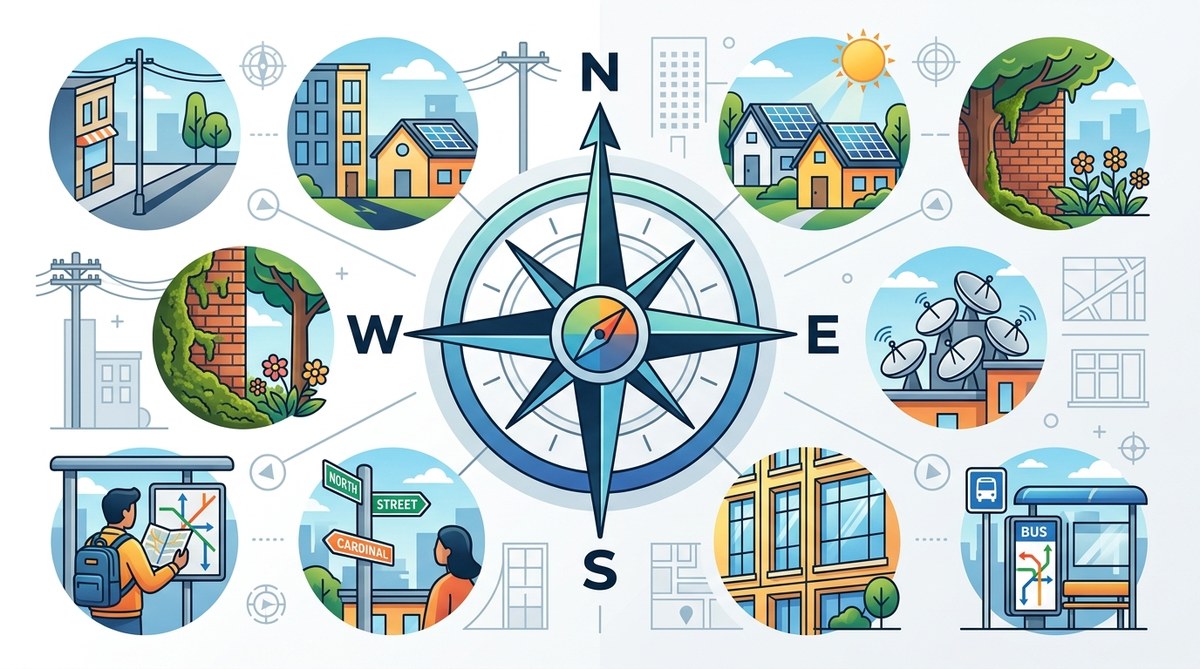
You step out of a subway station in a city you have never visited before. The buildings all look similar, the streets curve in unexpected ways, and your phone battery just dropped to two percent. In that moment, knowing how to find direction in a city without a compass feels like a superpower. The good news is that cities are full of hidden directional clues. You just need to know where to look.
You can determine north, south, east, and west in any city by reading shadows, street grids, architectural patterns, and even the growth of moss on buildings. These techniques work without a phone, a map, or a compass. With a little practice, you will never feel truly lost in an urban environment again, whether you are exploring a new neighborhood or traveling abroad.
Why Your Phone Is Not Your Best Navigation Tool
Relying on a smartphone for directions feels natural, but it has a hidden cost. Studies show that constant GPS use shrinks the hippocampus, the part of your brain responsible for spatial memory. The more you let an app guide you, the weaker your natural sense of direction becomes. That is a problem when the battery dies, the signal drops, or you find yourself in a city with confusing alleyways and no data plan.
Learning to read urban clues does more than save you in an emergency. It builds a mental map that makes every city feel smaller and more familiar. Once you understand the basic language of streets, shadows, and structures, you can walk into any downtown area and know which way is north within thirty seconds.
The Sun and Shadows: Your Oldest Compass
The sun still works the same way it did for explorers centuries ago. In the northern hemisphere, the sun rises in the east and sets in the west. At solar noon (around 1:00 PM during daylight saving time), the sun sits directly in the south. That means shadows point north at midday.
How to use shadows to find north
- Find a straight object like a lamppost, a signpole, or the edge of a building.
- Look at the shadow it casts on the ground.
- Note the time of day. In the morning, shadows point west. In the afternoon, they point east. At solar noon, they point due north.
- If the sun is hidden behind clouds, find the brightest part of the sky. Shadows will still be visible, just softer.
- Use a small stick or your own shadow if no pole is nearby. Stand still and mark where your shadow falls.
This method works best between 10:00 AM and 4:00 PM. Early morning and late evening shadows are long and less precise.
“The shadow of a vertical object is the most reliable compass you will ever have. It never needs batteries, and it never lies.” — Traditional navigation wisdom passed down by search and rescue trainers.
Reading the Street Grid
Many American cities were planned with a grid system. Streets running north-south are often numbered or named after trees, while east-west streets carry names of states or presidents. This pattern is not universal, but it is common enough to be useful.
What to scan for when you hit a new block
- Look at a street sign. Does it say “Oak Street” or “5th Avenue”?
- Check if the addresses increase or decrease as you walk. In most grids, numbers rise as you move away from a central baseline.
- Notice which side of the street has even numbers and which has odd numbers. Even numbers are typically on the north and west sides.
- Find a major thoroughfare. Wide boulevards often run along cardinal directions.
- Watch which direction traffic flows during rush hour. Morning traffic usually heads toward the city center, which is often east or south depending on the region.
For a deeper look at how these patterns work across different cities, check out this guide on master urban navigation techniques without using a map.
Architecture Tells a Story
Builders have always considered sunlight when designing structures. In the northern hemisphere, architects place more windows on the south side to capture natural light. The north side of a building tends to have fewer windows and more brick or stone.
Signs that reveal north and south
| Clue | What to look for | Direction it suggests |
|---|---|---|
| Moss on brick or stone | Thicker, greener growth | North side (shadier, moister) |
| Window placement | More windows, larger panes | South side (more sunlight) |
| Paint fading | More faded, chalky appearance | South and west sides (sun and weather) |
| Roof overhangs | Longer overhangs on one side | South side (shade from high sun) |
| Address numbers | Lower numbers or even numbers | North or west side of street |
Moss is a particularly handy clue in older cities with lots of brick buildings. It grows best on the damp, shaded north side. If you see a wall covered in green moss, you are likely looking at the north face of that structure.
How Churches and Public Buildings Point the Way
Older churches in the United States often follow a traditional layout. The altar sits at the east end, and the main entrance faces west. This is a carryover from European church design, where the building is oriented toward the rising sun.
Not every church follows this rule, but many do. If you see a historic stone church, walk around it and find the main doors. Those doors likely face west. The back of the church, where the altar sits, points east.
Public buildings like courthouses and city halls also tend to align with cardinal directions. Architects in the 19th and early 20th centuries often designed these buildings with symmetrical facades facing south. The grand entrance of a county courthouse frequently opens to the south, catching the most sunlight throughout the day.
The Wind and Weather Patterns
Prevailing winds can give you a sense of direction if you know the local climate. In most of the United States, weather systems move from west to east. That means wind often blows from the west.
How to feel your way north
- Stand still and close your eyes. Feel which direction the wind hits your face.
- Notice which sides of trees and bushes look more trimmed or bent. Constant wind from the west shapes vegetation over time.
- Look at flagpoles and banners. They point in the direction the wind is blowing.
- Check for weather stains on buildings. Rain and snow typically hit the east and north sides harder in many regions.
This technique works best on breezy days. On calm mornings, you may need to rely on other clues first.
Public Transit as a Directional Tool
Bus and train routes are not random. They follow major corridors that usually run along cardinal lines. In cities like New York, Chicago, and Washington D.C., subway lines are often named after their general direction. The “Red Line North” or “Blue Line East” labels are literal.
When you exit a station, look at the signs inside. They often list the last stop in each direction. If the train you just got off was heading toward “Uptown,” you were moving north. If it said “Downtown,” you were heading south.
Many bus stops also have route maps that show the full line. Take two seconds to glance at it. You will see the overall shape of the route and which direction the bus was traveling when you got off.
For more on using public infrastructure this way, read about how to use public transit as a navigation compass in 2026.
Common Mistakes That Throw Off Your Sense of Direction
Even experienced navigators make errors. Here are the most frequent pitfalls when trying to find direction in a city without a compass.
| Mistake | Why it fails | What to do instead |
|---|---|---|
| Trusting the phone compass without calibration | Phone compasses need a clear magnetic reading. Metal buildings and underground trains interfere. | Cross-check with a shadow or street grid. |
| Assuming all grids are perfect | Cities like Boston and Pittsburgh have chaotic street patterns. | Look for a major river or highway as a reference line. |
| Forgetting daylight saving time | Solar noon is not at 12:00 PM. It is closer to 1:00 PM in summer. | Adjust your shadow reading by one hour. |
| Relying on moss alone | Moss grows on the shadiest side, which is not always north in dense urban canyons. | Check three different buildings before deciding. |
| Ignoring the season | The sun arc changes throughout the year. Winter sun sits lower in the south. | Practice the shadow method in different months to build intuition. |
A Step-by-Step Process for Any City
When you step out of a train station or hotel and feel disoriented, run through this checklist. It takes less than a minute.
- Look at the sun or your shadow. If it is midday, your shadow points north. If it is late afternoon, the sun is in the west.
- Find a street sign. Read the name and see if it fits a grid pattern. “Maple” and “Elm” are often north-south. “1st” and “2nd” are often east-west.
- Check a nearby building. Which side has more windows? That is likely south. Which side has moss or darker brick? That is likely north.
- Feel the wind. If a breeze is hitting your left cheek, and you know the prevailing wind comes from the west, then you are facing south.
- Confirm with a second clue. Never rely on just one method. Combine two or three for accuracy.
If you want to strengthen these skills over time, consider learning how to train your brain for better urban spatial awareness. Regular practice makes these observations automatic.
What to Do When Every Clue Contradicts Another
Sometimes the sun is behind clouds, the streets curve every block, and all the buildings look identical. This happens most often in older European-style neighborhoods or cities built along rivers. When clues conflict, do not panic.
- Walk one block in a straight line. The street grid may shift, but most cities have at least one long straight road.
- Find a body of water. Rivers and lakes act as natural boundaries. In many cities, the river runs roughly north-south or east-west.
- Look for a tall landmark like a water tower, a radio antenna, or a skyscraper. These structures are often visible from far away and can serve as a fixed reference point.
- Ask a local. People who live in a city usually know which way is north, even if they cannot explain how. A simple “Which way is north?” works better than you think.
Why This Skill Matters More in 2026
We are more dependent on phones than ever, but that dependence comes with risk. Cell towers go down during storms. GPS signals can be jammed or spoofed. Phone batteries drain faster in cold weather. Knowing how to find direction in a city without a compass is not just a party trick. It is a basic safety skill.
Urban explorers, new city residents, hikers, and outdoor enthusiasts all benefit from rebuilding their natural navigation instincts. The more you practice, the more you notice the subtle clues that cities offer. That faded sign on a brick wall, the angle of a shadow at 3:00 PM, the way moss clings to the north side of a stone church. These details become second nature.
Putting It All Together on Your Next Walk
The next time you step outside, leave your phone in your pocket. Pick a street corner and try to determine north using only what you see around you. Check the shadows. Look at the building windows. Feel the breeze. Read the street sign. Within a few tries, you will start to see the city as a living compass.
This is not about memorizing facts. It is about training your eyes and your instincts to notice what has always been there. Cities were built with intention, and that intention includes the sun, the wind, and the ground beneath your feet. Once you learn to read those signals, you will never need to ask for directions again.
For more ways to sharpen your skills, check out these top strategies for navigating cities intuitively in the digital age. The more tools you have, the more confident you will feel in any urban environment.