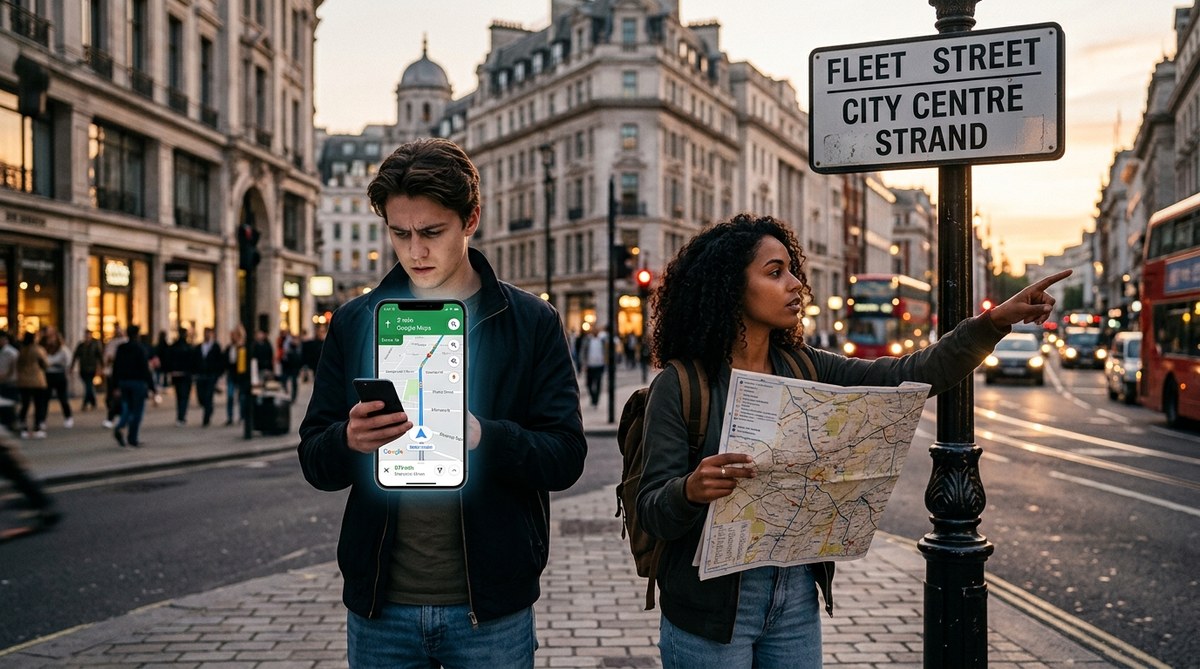
You pull out your phone, type in an address, and a blue line guides you turn by turn. You never have to think about where you are, where you are going, or how you got there. It feels like magic. But there is a hidden cost to that convenience. Research in cognitive neuroscience shows that heavy GPS use literally changes your brain. Your hippocampus, the region responsible for spatial memory and mental mapping, becomes less active when you outsource navigation to a device. Over time, this leads to a measurable decline in your natural sense of direction. The good news is that your brain is plastic. You can train it back.
GPS kills your sense of direction by preventing your brain from forming mental maps. When you follow a blue dot, your hippocampus goes dormant. To fix it, you need to switch from passive guidance to active navigation. Use landmarks, build cognitive maps, and practice wayfinding without step by step instructions. Your brain can recover these skills at any age.
What Happens to Your Brain When You Use GPS
Think of your sense of direction like a muscle. The more you use it, the stronger it gets. The less you use it, the weaker it becomes. GPS acts like a crutch that lets your spatial thinking muscles atrophy.
A landmark 2020 study from University College London tracked London taxi drivers who had to memorize the city’s 25,000 streets for their license exam. These drivers had larger, more active hippocampi than the average person. But when GPS became common, newer drivers showed less of that growth. The brain adapts to what you demand from it. If you demand nothing, it stops investing resources.
Your phone does the heavy lifting for you. It calculates distance, direction, and timing. It even tells you when to turn before you can see the street sign. You are not navigating. You are following instructions. This difference is critical. Navigation requires active problem solving. Following instructions requires passive obedience.
The Three Main Ways GPS Harms Your Navigation Skills
There are three specific ways that relying on GPS degrades your natural abilities. Understanding them helps you target your recovery.
- Reduced mental map building. When you navigate without GPS, your brain builds a cognitive map, a bird’s eye view of an area. You learn how streets connect, where landmarks sit, and which routes feel right. GPS removes the need for this. You never form the map in the first place.
- Loss of landmark memory. Humans are naturally good at remembering visual cues, a distinctive building, a weird sign, a park with a fountain. GPS directs your eyes to the screen, not the environment. You stop noticing what is around you.
- Weakened spatial awareness. Knowing which direction is north or estimating how far you have walked are skills that fade without practice. GPS does these calculations for you, so your brain stops trying.
A Practical Process to Rebuild Your Sense of Direction
You can reverse the damage. The process is simple, but it requires intention. Here is a numbered list of steps to start today.
- Look at the map before you leave. Instead of typing an address and hitting go, open the map app and study the route. Notice the shape of the streets. Identify two or three landmarks along the way. Close the app. Try to hold that mental picture as you walk or drive.
- Turn off voice guidance. Your ears are powerful navigation tools. When a robotic voice tells you to turn left in 200 feet, you stop listening to the world. Turn off the voice. Use the visual map on screen only when you need a check. This forces your brain to pay attention to the environment.
- Try one trip per week without GPS. Pick a destination you know vaguely, a friend’s house, a grocery store, a park. Leave your phone in your pocket. Use only your memory and the world around you. If you get lost, that is fine. Getting lost is how your brain learns. It strengthens the hippocampus like a good workout.
- Practice cardinal directions. Every time you step outside, ask yourself which way is north. Use the sun as a guide. In the morning, the sun is in the east. In the afternoon, it is in the west. After a few weeks, you will start to feel north in your bones.
Common Mistakes When Trying to Navigate Without GPS
Even with good intentions, people often fall into traps that keep them dependent on their phone. The table below shows the most common mistakes and how to avoid them.
| Mistake | Why It Hurts | What to Do Instead |
|---|---|---|
| Looking at the phone every block | Prevents you from building a mental map of the area | Put the phone in your bag. Check it only at major intersections. |
| Using GPS for familiar routes | Keeps your hippocampus inactive | Leave the phone at home for your daily commute. Use your memory. |
| Ignoring the sun and shadows | Misses a free, reliable directional cue | Notice where the sun is when you start your trip. Use it as a compass. |
| Relying on estimated arrival times | Tricks your brain into thinking time is distance | Estimate your own travel time based on landmarks. See if you are right. |
“The best navigators are not the ones who never get lost. They are the ones who know how to find their way back.” This advice from a veteran search and rescue instructor reminds us that getting turned around is part of the process. The skill is in the recovery, not the avoidance.
How to Start Seeing Your City Differently
The real fix for a GPS killed sense of direction is to change how you see the world. Instead of a collection of streets to be processed by an app, see your city as a puzzle. Every building, every intersection, every shadow is a clue.
Start with your own neighborhood. Walk around the block without any device. Notice the architecture. Which houses have big trees? Where does the road bend? What does the air smell like near the bakery? These sensory details are the building blocks of a mental map.
When you visit a new part of town, resist the urge to pull up the map immediately. Spend the first five minutes just looking. Find the tallest structure. Note the flow of traffic. Listen for the sound of a train or a highway. Your brain is collecting data. Give it time to work.
For a deeper look at this approach, check out these top tips for developing natural wayfinding skills in urban environments. They build directly on the idea of using your senses instead of your screen.
Why Your Phone’s GPS Is Making You Forget the City
There is a concept in psychology called cognitive offloading. It is the tendency to use a tool to reduce the mental load of a task. GPS is the ultimate cognitive offloading device. You offload your spatial memory to the cloud. The problem is that your brain treats that offloaded memory as irrelevant. If you never need to remember a route, your brain stops trying to encode it.
This is why you can drive to the same coffee shop for a year using GPS and still not know how to get there without it. Your brain never stored the information. It trusted the phone.
The fix is to force retrieval. Try this exercise: after a GPS guided trip, close the app and try to draw the route from memory on a piece of paper. Include the street names, the turns, and any landmarks you remember. You will be surprised how little you recall at first. Keep doing it. Your recall will improve.
A Weekly Routine to Restore Your Direction
Consistency matters more than intensity. Here is a gentle weekly routine to rebuild your skills.
- Monday: Walk to a nearby destination without your phone. Use only the sun and street signs.
- Wednesday: Take a bus or train to a stop you have never used. Walk the last half mile without GPS. Use the buildings and street layout to find your target.
- Friday: Drive to a friend’s house using only your memory. If you get stuck, pull over and look at a paper map or a static image on your phone. Do not use turn by turn directions.
- Sunday: Go for a walk in a park or natural area. Trails rarely have address numbers. You have to rely on trail markers, the sun, and your own sense of direction.
This routine is designed to be low stakes. The goal is not perfection. The goal is to turn your brain back on.
How to Use Landmarks Like a Pro
Landmarks are the most powerful tool for natural navigation. They anchor your mental map. They give you a sense of scale and direction. But you have to learn how to choose the right ones.
Good landmarks are:
– Visible from a distance (a tall building, a water tower, a church steeple)
– Unique in color or shape (a bright mural, a curved bridge)
– Fixed in place (not a food truck or a seasonal market)
Bad landmarks are:
– Generic (a Starbucks, a bank, a gas station)
– Temporary (construction sites, holiday decorations)
– Small and easy to miss (a mailbox, a fire hydrant)
When you enter a new area, scan for three good landmarks immediately. Note their position relative to each other. This gives you a triangulation point. If you get lost, you can always find your way back to one of them.
For more on this concept, read about how to navigate any city using only landmarks and directional cues. It explains how to turn a simple water tower into a reliable compass.
The Role of Technology in 2026
This is not a call to throw away your smartphone. Technology is useful. It saves time and reduces stress in unfamiliar places. The problem is not the tool. The problem is dependency.
In 2026, we have more navigation tools than ever. Wearables, augmented reality overlays, and real time traffic data. But these tools are best used as supplements, not replacements. Use GPS to find a new restaurant across town. Then turn it off for the walk from the train station to the front door. Use GPS to check traffic on your commute. Then navigate the last mile from memory.
The goal is balance. You want to be the kind of person who can use GPS when it helps, but can also find their way when the battery dies or the signal drops.
Reclaiming the Lost Art of Urban Navigation
Every generation has skills that fade as technology advances. We no longer churn butter or mend our own clothes. That is fine. But some skills are worth keeping. Navigation is one of them. It connects you to your environment. It builds confidence. It turns a simple walk into an adventure.
The next time you step out the door, try something small. Look at the sky. Feel the wind. Notice the way the light falls on the street. Your phone can wait. Your brain is ready to work.
Start today. Leave the GPS off for one trip this week. See what you notice. See how it feels. You might be surprised at how much your brain remembers when you give it a chance.