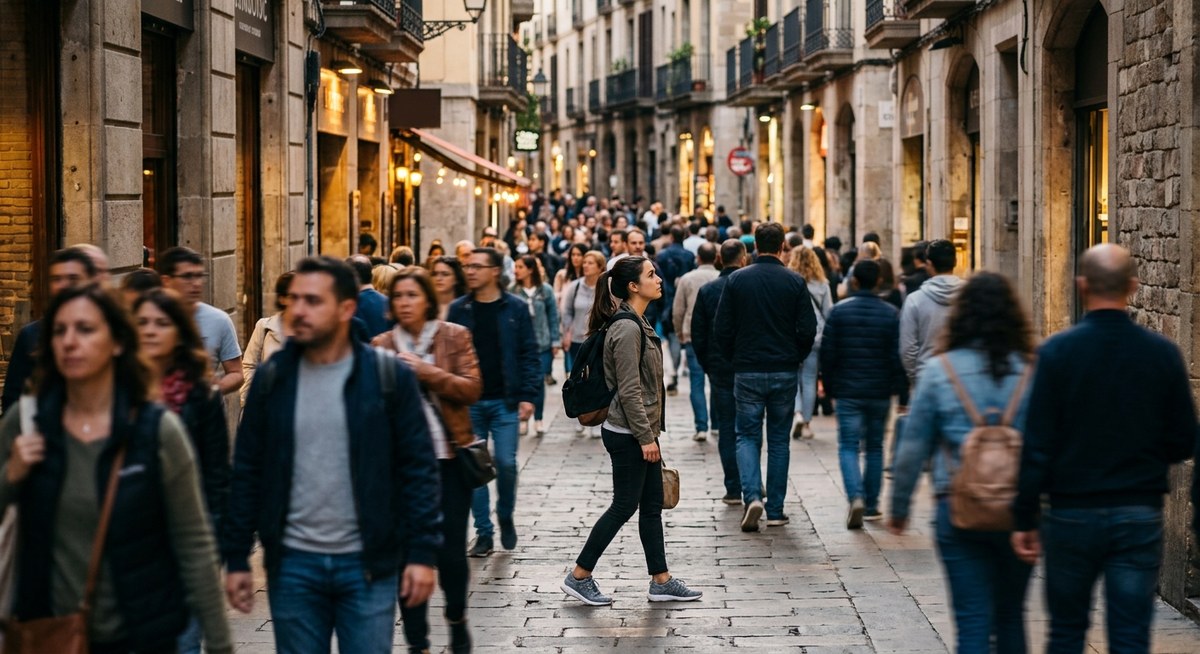
You step off a train in a city you have never visited. Your phone battery is dead. The street signs are in a language you can barely pronounce. Panic wants to set in, but then you notice something: people are flowing around you like a river. Some are walking with purpose, others meander. At that moment you realize the crowd itself can show you the way. This is not guesswork. It is a skill you can learn. By paying attention to how people move, where they congregate, and which directions they face, you can navigate unfamiliar cities using crowd behavior as your compass.
Crowd behavior is a reliable, free navigation tool. By observing foot traffic patterns, local habits, and group movements, you can orient yourself, find attractions, and avoid dead ends without a map. This guide gives you a step-by-step method to read any city’s human flow and turn it into direction.
Why Crowd Behavior Works as a Navigation Tool
Cities are living organisms. People move in predictable ways. Commuters head toward transit hubs in the morning. Tourists cluster around landmarks. Locals cut through alleys to save time. Researchers call this “collective wayfinding.” When you learn to read it, you tap into centuries of shared knowledge.
Think of a public square at 8 AM. Workers stream out of a subway exit and fan into office buildings. By 10 AM, the flow reverses slightly as late risers grab coffee. At noon, the crowd shifts toward lunch spots. These rhythms repeat daily. If you watch for five minutes, you can guess where the main transit lines run, where the business district ends, and where the food scene begins.
The best part? You do not need language skills. Body language, pace, and direction are universal. A group of people walking with shopping bags likely came from a market or retail area. A steady stream of people wearing backpards heading away from a plaza probably just left a museum. These clues are free and always available.
How to Read the Crowd
To navigate unfamiliar cities using crowd behavior, follow this numbered process. Practice each step until it becomes second nature.
-
Find a high-vantage point. Stand on a bridge, a staircase, or a balcony. Look down at the street. Ignore individual faces. Watch the flow. Where are most people coming from? Where are they going? Identify the main arteries of movement.
-
Identify the dominant direction. At any given time, one direction will have more foot traffic. In the morning that is often toward business centers. In the evening, toward residential areas or transit. Follow the dominant flow and see where it leads. After ten minutes, you will reach a main square, station, or market.
-
Look for clusters. Crowds gather for a reason. A cluster outside a building means either an entrance, a bus stop, or a popular viewpoint. Walk toward it. Read the signs. Even if you cannot understand the language, the crowd’s shape tells you what is important.
-
Note changes in pace. People slow down near attractions, shops, and street performers. They speed up on sidewalks that lead to transit. If a street suddenly empties, it might be a dead end or a dangerous area. Trust the collective instinct.
-
Spot the locals. Tourists walk slowly, look up at buildings, and check phones. Locals walk with confidence, know shortcuts, and ignore visual clutter. Spot a person who seems completely at ease. Follow them discreetly for a block. They will likely lead you to a transit hub or a neighborhood hub.
-
Use the “follow the sun” rule combined with crowd movement. In the Northern Hemisphere, the sun is in the south at noon. If you see a crowd moving away from the sun in the morning, they are likely heading north. Combine this cardinal direction with crowd flow to build a mental map.
What to Look For
When you scan a street, train your eyes on these specific signals. Use this bulleted list as a mental checklist.
- Walking speed: Fast walkers = urgent destinations (stations, offices). Slow walkers = leisure areas.
- Briefcase vs. backpack: Business areas have more briefcases or laptops bags. Tourist zones have more backpacks and cameras.
- Laughter and conversation volume: Quiet, purposeful walkers are commuters. Laughing, chatting groups are exploring.
- Eye direction: People looking upward or sideways are searching for landmarks. People looking straight ahead know where they are going.
- Phone usage: A person staring at a phone is likely navigating. A person with phone in pocket is familiar with the area.
- Carrying items: Unopened umbrellas on a cloudy day mean locals trust the weather forecast. Open umbrellas mean rain is expected.
- Crosswalk behavior: Locals jaywalk only where it is safe and normal. Tourists wait for the walk signal. Watch where locals cross.
Common Mistakes vs. Smart Techniques
Many travelers try to use crowd behavior but make errors. The table below separates the good from the bad.
| Mistake | Better Technique |
|---|---|
| Following a single person blindly | Observe groups of at least five people moving in the same direction |
| Trusting your first impression | Watch the same intersection for three full minutes to see the pattern |
| Ignoring time of day | Adjust your reading for rush hour, lunch time, and late night |
| Focusing on individuals | Scan the entire street as a moving system |
| Assuming all crowds are helpful | Separate tourist crowds (irregular, slow) from local crowds (steady, purposeful) |
| Forgetting to check for one-way streets | Crowds moving against a one-way street may be taking a shortcut |
| Giving up after one wrong turn | Use the mistake as data. Reassess the flow from a new vantage point |
Expert Advice
Street Learn contributor and urban navigation specialist Marta Chen has spent years studying pedestrian flow in cities from Tokyo to Mexico City. She offers this insight:
“The most common mistake is trying to read the crowd like a map. You are not looking for a route. You are looking for confirmation. Trust the direction that feels natural. If you feel like you are swimming upstream, you probably are. The crowd is a river. Your job is to float, not to fight.”
This mindset shift is critical. When you navigate unfamiliar cities using crowd behavior, you are not following orders. You are reading a living system. The best navigators stay loose, curious, and ready to change direction.
Crowd Behavior in Different City Scenarios
Crowd behavior varies depending on the city type. In a grid city like Chicago, locals tend to walk in straight lines. In an organic city like Boston, paths curve and merge. In a tourist heavy city like Orlando, crowds cluster around theme parks and hotels.
- Transit hubs: Watch the exit patterns. Two minutes after a train arrives, a wave of commuters flood the street. Follow that wave to see where the main thoroughfares are.
- Market districts: People carry bags and move slowly. Follow the direction of the heaviest bag traffic. It usually leads to the main market entrance.
- Residential areas: Few people walk during work hours. The streets are quiet. If you see a steady stream of people at 9 PM, they are likely heading to entertainment or dining.
- Monuments and landmarks: The crowd flows inward toward the attraction. If you want to find a famous site, look for the direction where people are walking with cameras out.
Strengthen Your Instincts
Reading crowds is a skill that improves with practice. Start in your own city. Spend ten minutes at a busy intersection. Write down what you observe. Which direction do most people walk at 5 PM? Where do they stop? How do they behave when it rains? This baseline training makes it easier when you travel.
For deeper practice, check out these related guides:
- Developing natural wayfinding skills in urban environments helps you spot patterns faster.
- Learning to use environmental cues for accurate urban wayfinding complements crowd reading.
- Understanding how to navigate urban jungles using sound and sight cues adds another layer of awareness.
Each skill stacks on the others. Soon you will not need a GPS at all.
When the Crowd Leads You Astray
No method is perfect. Sometimes crowds can mislead you. A street festival might pull a crowd in the wrong direction. A marathon reroutes pedestrians. A protest changes flow patterns. In those cases, fall back on other skills.
Look for alternative signals: the position of the sun, the shape of buildings, the sound of traffic. If you are truly lost, find a high point and reassess. The crowd is your primary tool, but not your only one. Keep a backup orientation method in mind.
Also, trust your gut. If the crowd feels wrong, stop and observe longer. Do not follow blindly. Groups of people making a mistake all together still makes a mistake. Use your judgment.
Turning the Crowd into Your Personal Guide
Let us run through a real scenario. You are in Rome, near Termini station. Your phone died. You want to reach the Colosseum. What do you do?
First, stand at the station exit. Watch the crowd. You see a large group of people with cameras and backpacks walking south down Via Giovanni Giolitti. They are moving away from the station at a relaxed pace. A smaller group of locals walks west, faster, without looking around.
You follow the camera group. After five minutes they pause at a crosswalk. You see a sign for the Colosseum. The crowd turns left. You stay with them. Within two minutes, the Colosseum appears ahead.
You did not need a map. You used the collective knowledge of hundreds of travelers before you. They found the way, and you rode their momentum.
Master the Art of Crowd Navigation
The ability to navigate unfamiliar cities using crowd behavior is not magic. It is observation, patience, and a little trust. Next time you step off a train in a strange place, take a breath. Watch. Let the city show you its secrets. The crowd knows where it is going. With practice, you will know too.
Go ahead and try it this week. Pick a busy street near your home or a nearby town. Spend fifteen minutes studying the flow. Notice how much you can deduce. Then pack that skill for your next trip. You might just find that getting lost is no longer a fear but an opportunity to read the city like a local.