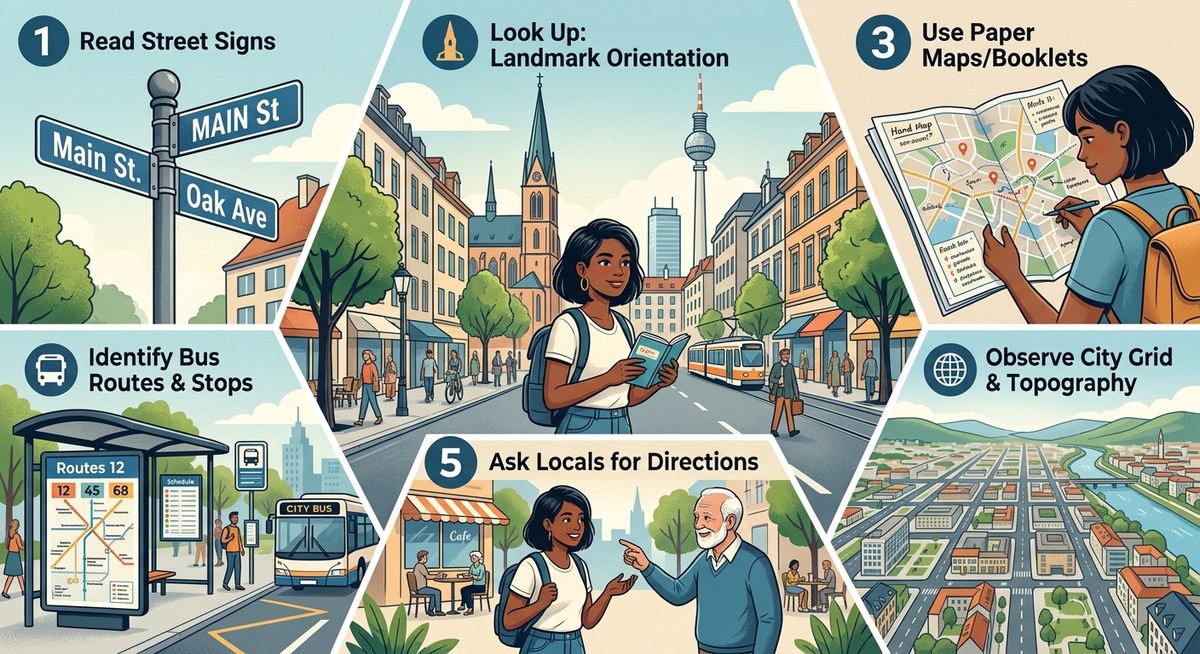
Your phone has been your guide through every unfamiliar neighborhood, and now the screen is black. The battery gave up somewhere between that last coffee shop and the hotel you are trying to find. Panic starts to creep in. You look around at a sea of buildings with no idea which way is north. This moment happens to millions of urban commuters and travelers every year. But you do not need an app to find your way. With a few techniques and a shift in mindset, you can move through any city with confidence, even when your phone is dead.
Urban navigation without a phone relies on reading the environment: using the sun, street signs, foot traffic, landmarks, and public transit maps. This guide gives you six practical hacks and supporting techniques so you never feel lost when your battery dies. Build these habits now and you will navigate any city like a local, no device required.
Why Smartphone Overreliance Is a Problem
Most of us have outsourced our sense of direction to a tiny computer in our pocket. That works great until it doesn’t. Studies show that even a short walk while staring at a phone reduces spatial awareness. You stop noticing street names, building shapes, and the angle of the sun. When the screen goes dark, you have none of that mental map to fall back on.
Think about the last time you visited a new city in the United States. Did you memorize the layout of downtown, or did you just follow a blue dot on a map? If you are like most people, you let the phone do the work. The good news is that you can train yourself to see the urban environment differently. You already have all the tools you need: your eyes, your ears, and a basic understanding of how cities are laid out.
The Six Urban Navigation Hacks That Work Without a Phone
These hacks are simple to learn and easy to practice on your next walk, even if your phone still has battery. Start using them now so they become second nature.
-
Read the Sun and Shadows. The sun rises in the east and sets in the west. In the northern hemisphere, at noon the sun is due south. Look at where shadows fall. In the morning, shadows point west; in the afternoon, they point east. In 2026, you can check the exact solar noon for your city online ahead of time, but a rough estimate works just fine. Stand in a open spot, note the sun’s position, and you instantly know your cardinal directions.
-
Use Street Grid Logic. Many U.S. cities were planned on a grid. Streets run north-south, avenues run east-west (or vice versa). Even older cities like Boston or San Francisco have patterns. Look at a street sign. Often it tells you the block number, which helps you estimate distance from a central point. For example, in Manhattan, street numbers increase as you go north. If you are on 34th Street and need to get to 42nd, you know to walk north.
-
Follow Foot Traffic and Car Flow. People and vehicles tend to move toward major transit hubs, commercial districts, or popular intersections. If you are lost, watch the general direction most pedestrians are walking during lunchtime or rush hour. They are heading toward subways, bus stops, or restaurants. Follow them for a few blocks and you will likely hit a recognizable street or landmark. Car traffic often flows toward highways or downtown areas.
-
Find a Public Transit Map. Bus stops and subway stations almost always have a system map posted. Even if you do not ride the train, the map shows the street layout and major landmarks. In many U.S. cities, transit maps are designed to be easy to read from a distance. Look for a station entrance, step inside, and study the map. It gives you your location and shows how the city is connected.
-
Spot Unforgettable Landmarks. Every city has them: tall buildings, water towers, stadiums, parks, or unusual architecture. Before you start moving, identify three distinctive landmarks in different directions. Use them as reference points. For instance, if you can see a church steeple to the east and a radio tower to the north, you can triangulate your position. Over time, your brain builds a mental anchor system that works even at night.
-
Ask Residents and Business Owners. This sounds obvious, but many people hesitate because they feel embarrassed. Most locals are happy to help a lost traveler. Walk into a coffee shop, a newsstand, or a convenience store. Say, “I’m trying to find this address, could you point me in the right direction?” You get a personal guide in exchange for ten seconds of conversation. In 2026, many store owners have paper maps behind the counter they can give you for free.
What to Scan for When You Lose Your Bearings
When your phone dies, take a pause and scan your surroundings. Look for these clues in order.
- Sunrise / sunset direction
- Street name signs and numbered blocks
- Major intersections and highway signs
- Pedestrian flow in a single direction
- Visible landmarks that stand out (tall buildings, bridges, park edges)
- Water features like rivers or lakes
- Transit signage with neighborhood names
- Solar panels or satellite dishes (they often face south)
- Wind direction from flags or trees (helps with orientation in flat areas)
Common Mistakes and Better Alternatives
Not every method works in every city. Some techniques fool you if you do not check the details. This table shows typical mistakes and what to do instead.
| Mistake | Why It Fails | Better Alternative |
|---|---|---|
| Trusting a mobile map screenshot that is two years old | New construction or street changes can render it wrong | Look at a static transit map or ask a local |
| Following the sun at midday without checking the season | In summer, the sun is higher and less directional; in winter, it is lower | Note the time of day and adjust your expectation |
| Relying on a single landmark that is also visible from many places | Tall buildings look similar from different angles | Pick three landmarks in a triangle around you |
| Walking toward traffic noise assuming it leads to downtown | Some highways bypass the center | Listen for train horns or subway rumble, which signal transit hubs |
| Using a building’s street number to guess cross streets | Many cities skip numbers or have odd/even side rules | Look at the 100-block system (typical in grid cities) |
“The best navigators are not the ones with the biggest phones. They are the ones who stop, observe, and let the city tell them where to go.”
— Sarah Mendez, former search and rescue coordinator and urban navigation instructor
Building an Emergency Navigation Kit for Your Pocket
You do not need a heavy backpack. A few small items can save you. Keep these in your bag or jacket when you travel.
- A mini compass (keychain size)
- A printed map of the city you are visiting (folded to fit a pocket)
- A small notepad and pen to write down directions
- A backup battery pack (obviously, but keep it charged)
- A wristwatch (to judge time and sun position)
Even without these items, the techniques above work. Your senses and a bit of patience are the only gear you truly need. For more advanced practice, consider reading https://streetlearn.cc/master-urban-navigation-without-maps-using-these-essential-skills/ to deepen your understanding of wayfinding without tech.
How to Practice When Your Phone Is Still On
You do not have to wait for an emergency. The next time you walk to a coffee shop or run an errand, try this. Keep your phone in your pocket. Before you set out, look at a map for one minute. Then put it away. Navigate using only street signs, landmarks, and the sun. If you get turned around, stop and reorient using the hacks above. That short practice builds neural pathways that will kick in automatically when the screen goes dark.
Why This Matters for Travelers in 2026
We carry powerful devices, but they are fragile. Water, cold, a cracked screen, or a dead battery can cut you off. Urban navigation without a phone is not a retro skill reserved for hikers. It is a practical tool for anyone who steps into a city. The more you rely on your own brain, the more you notice the details that make a place unique. You start to see the subtle ways that cities are designed to guide you. And you never again feel helpless because your charge ran out.
Your First Step to Confident City Walking
Try one hack today. The next time you are outside, look up at the sun and guess which direction you are facing. Then check with a compass app or a street sign. Do that five times this week. By the end of it, you will have a stronger internal compass. That confidence changes everything. You will stop worrying about battery life and start enjoying the walk. The city is waiting. Go find your way.